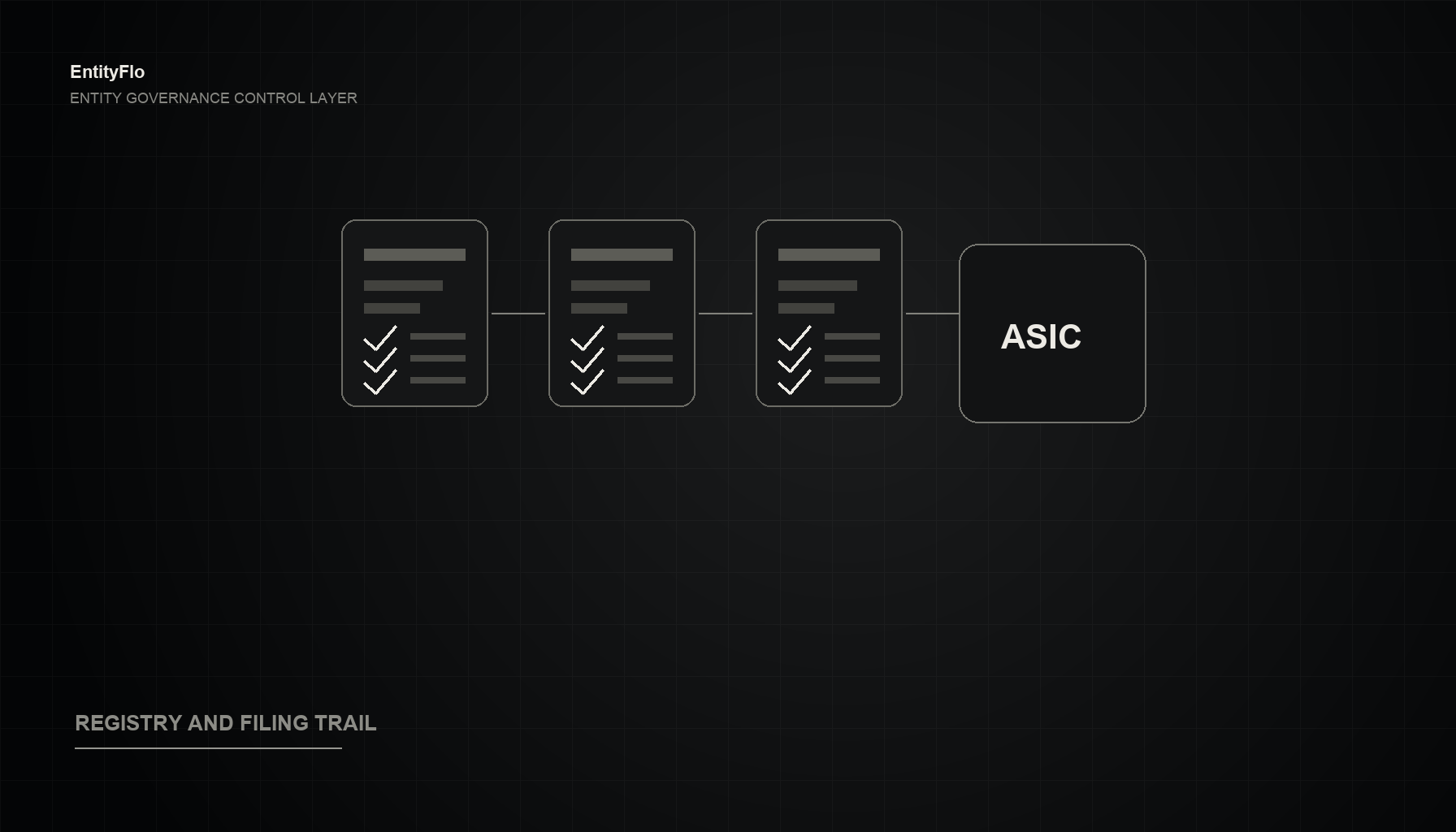
ASIC compliance is not one annual task.
It is a set of records, filings, decisions and deadlines that need to stay aligned all year. The problem for most companies is not that they do not know ASIC exists. The problem is that responsibility is split across legal, finance, advisers, email, spreadsheets and the ASIC portal.
This checklist is for Australian companies that want a practical way to keep their ASIC obligations under control.
Quick answer: what should you check?
At minimum, check:
- company name, ACN and registered details
- registered office and principal place of business
- directors and secretaries
- shareholder/member records
- share structure and recent changes
- annual review date and company statement
- solvency resolution or equivalent approval record
- ASIC lodgement history
- outstanding fees, late fees or notices
- supporting documents for every filed change
- internal registers and minutes
- who owns the next action
If any of those are wrong, missing or not supported by evidence, the company has a compliance gap.
1. Confirm the company details
Check the current ASIC record against the internal company record:
- legal name
- ACN
- registered office
- principal place of business
- ultimate holding company, if relevant
- review date
- company type
Do not assume ASIC is correct. ASIC reflects what has been lodged. If a change was approved internally but not filed, or filed but not reflected internally, the records are still out of sync.
2. Check directors and secretaries
Confirm:
- current directors
- current company secretary, if appointed
- appointment and cessation dates
- names and addresses
- consent to act records
- related resolutions or minutes
- whether any recent change needed an ASIC lodgement
ASIC provides guidance on changing company details. The operational point is simple: when a director or secretary changes, the internal record, evidence and ASIC filing need to move together.
3. Check shareholders and members
Review the register of members:
- current shareholders
- share classes
- number of shares
- amount paid and unpaid
- transfer history
- issue history
- cancelled or bought-back shares
- supporting documents
This is where many companies become messy. A cap table may show one position, the share register another, and historical documents a third. The register should be the controlled record.
4. Review recent company changes
Look back over the last 12 months and ask whether any event should have triggered an update:
- director appointment or resignation
- secretary appointment or resignation
- registered office change
- principal place of business change
- share issue
- share transfer
- company name change
- ultimate holding company change
- constitution change
- ownership or control change
For each event, confirm there is a decision record, evidence, register update and filing status.
5. Check annual review status
Every Australian company should know:
- its annual review date
- whether the company statement has been received
- whether the annual review fee has been paid
- whether company details were checked
- whether a solvency resolution or required approval was completed
- where the evidence is stored
This article is not trying to replace a dedicated annual review guide. The compliance checklist point is broader: the annual review is one recurring control inside the company record.
6. Check ASIC fees, notices and late items
Confirm whether there are:
- unpaid annual review fees
- late fees
- outstanding notices
- rejected lodgements
- correspondence sitting with an adviser
- reminders going to the wrong email or person
Late fees and missed notices are often a symptom of poor ownership. The fix is not just paying the fee. The fix is making sure future notices route to the right owner and show up in the compliance calendar.
7. Check internal registers
The internal records should support the ASIC position.
Review:
- register of members
- officer/director records
- share issue and transfer records
- minutes and resolutions
- address records
- governing documents
- document evidence for filed changes
If the internal register and ASIC record disagree, document the mismatch and decide which system needs to be corrected.
8. Check document evidence
For each important change, there should be evidence:
- signed consents
- resolutions
- minutes
- share transfer forms
- share certificates or issue documents
- ASIC lodgement receipts
- correspondence
- approvals
Compliance is not just a filed form. It is the ability to prove why the filing was made and who approved it.
9. Assign every gap to an owner
Do not end the compliance review with a long list of issues.
Turn each gap into an action:
- what needs to be fixed
- who owns it
- what evidence is required
- whether ASIC needs to be notified
- deadline
- status
That action layer is what stops compliance reviews becoming another spreadsheet.
What this checklist is not
This is not an annual review article. It is not a Form 484 lodgement guide. It is not a corporate register setup guide.
Those are separate search intents:
- annual review: review date, company statement, fee, solvency
- Form 484/company changes: lodging specific changes with ASIC
- corporate register: internal record setup and maintenance
- compliance calendar: upcoming deadlines and reminders
This page is the master ASIC compliance checklist. It should link out to the specific guide when the reader needs deeper instructions.
Where software helps
ASIC compliance becomes difficult when the record and the workflow are separate.
EntityFlo helps by keeping ASIC details, company records, documents, filings, obligations and evidence connected. When something needs attention, it becomes an action with an owner, not another reminder buried in an inbox.
For growing groups, that matters because ASIC risk is rarely one big failure. It is usually a series of small record gaps that compound over time.
Practical ASIC compliance checklist
Use this monthly or quarterly:
- confirm company details match ASIC
- confirm officers are current
- confirm shareholders and share structure are current
- review changes made since the last check
- confirm annual review status
- check unpaid fees, notices and correspondence
- reconcile internal registers
- attach evidence for every filed change
- assign unresolved gaps
- update the compliance calendar
If you can complete those ten checks, you have a much better handle on ASIC exposure.
FAQ
What are the main ASIC compliance requirements for a company?
Companies need to keep ASIC and internal records current, maintain required registers, notify ASIC of certain changes, complete annual review requirements, pay required fees, and retain evidence for decisions and filings.
How often should ASIC compliance be checked?
At minimum, check it around the annual review. For multi-entity groups, a monthly or quarterly review is safer because director, shareholder, address and filing changes can happen throughout the year.
What is the biggest ASIC compliance risk?
The biggest practical risk is record drift: internal records, ASIC details, documents and responsibilities no longer match. That creates exposure when a deadline, audit, transaction or dispute reveals the mismatch.
Does ASIC compliance software replace advisers?
No. Software helps track records, deadlines, evidence and actions. Advisers are still important for legal, tax or complex filing advice.
How does EntityFlo support ASIC compliance?
EntityFlo keeps ASIC-related records, filings, documents, obligations and actions in one entity record so teams can see what is current, what is missing and what needs to be fixed.