Best Entity Management Software in Australia (2026)
Compare the best entity management software in Australia for ASIC compliance, registers, ownership, board actions and governance operations.
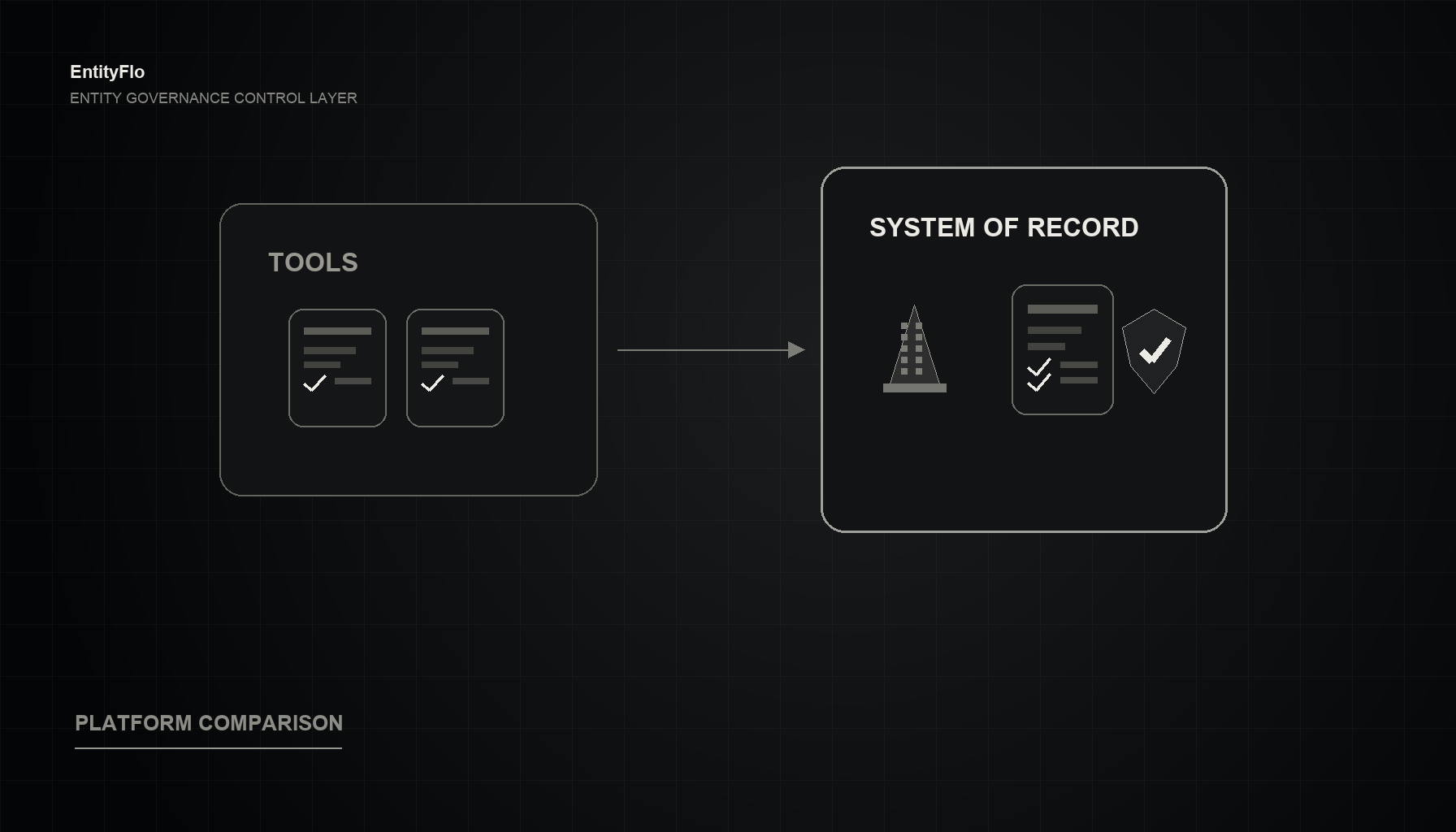
The best entity management software Australia has to offer in 2026 should do more than hold a list of companies. For CFOs, General Counsel and Company Secretaries managing 50 to 200+ entities, the real requirement is a live governance system that keeps ASIC filings, registers, ownership, approvals, board actions and evidence aligned.
Australian corporate groups have a specific operating reality. They deal with ASIC obligations, Australian company registers, trusts, trustee companies, SPVs, director changes, annual reviews, shareholder records, beneficial ownership requests and board approvals. A global database that does not fit those workflows can become another place to reconcile.
This guide compares the main options teams usually consider: EntityFlo, Kuberno, Athennian, Diligent, CAS 360 and NowInfinity. It is general information only, not legal advice.
What To Look For In Entity Management Software Australia
Entity management software Australia buyers should evaluate the work around the record, not only the record itself. Most tools can store company names, ACNs, officers and addresses. The harder question is whether the platform helps your team keep those records current when governance work happens.
For Australian corporate groups, the core evaluation criteria should include:
- ASIC registry sync and change detection
- Direct or supported ASIC lodgements
- Annual review and obligation tracking
- Company registers, including members, officers and charges where relevant
- Trusts, trustee companies and non-company entities
- Ownership charts and UBO pathway visibility
- Board and shareholder approvals connected to entity changes
- Document generation, execution evidence and audit trails
- AI-assisted drafting, checking and workflow triage
- Reporting for CFO, legal, board and adviser use cases
- Implementation effort for a mid-market corporate group
The best system should reduce reconciliation. If a director appointment is approved, the platform should help the team generate the documents, update the register, manage ASIC filing requirements, record evidence and keep the entity profile current. If it only stores the final state, the team still runs the operation in email, spreadsheets and portals.
Quick Comparison: Entity Management Software Options
| Platform | Best Fit | Strengths | Limitations For Australian Teams | |
|---|---|---|---|---|
| EntityFlo | Australian corporate groups managing 50-200+ entities | AU-first governance operations, ASIC workflows, registers, ownership, approvals, AI workflows | Newer category compared with long-established global systems | |
| Kuberno | Large listed and multinational groups | Strong entity governance focus, global structures, enterprise controls | Australian-specific ASIC and trust workflows should be checked closely | |
| Athennian | Global legal and governance teams | Modern entity data platform, ownership charts, collaboration | May require configuration for Australian ASIC-heavy operations | |
| Diligent | Large enterprise governance and board environments | Broad governance suite, board and risk ecosystem | Can be heavier than needed for mid-market entity operations | |
| CAS 360 | Accounting and corporate compliance practices | ASIC compliance workflows, annual reviews, practice-friendly | Built more for firms/advisers than internal group governance operations | |
| NowInfinity | Accountants, lawyers and document-heavy workflows | Legal documents, corporate changes, ASIC-related processes | Less suited as a live operational system for complex internal groups |
No product is universally best. The right answer depends on entity volume, internal ownership, ASIC exposure, complexity of trusts and ownership, and whether the team wants a database or an operating platform.
EntityFlo: AI-Native, Australian-First Governance Operations
EntityFlo is built for Australian corporate groups that have outgrown spreadsheets, inboxes and legacy entity management tools. It is not only a place to store entities. It is an AI-native governance operations platform for the work that keeps entities compliant and board-ready.
EntityFlo is designed around Australian governance workflows: ASIC filings, company registers, ownership records, structure charts, approvals, compliance obligations and evidence trails. That matters for groups where the governance record changes every week, not once a year.
The platform is strongest where internal teams need one live system for:
- entities, companies, trusts, subsidiaries and SPVs
- ASIC compliance software workflows
- annual reviews and change lodgements
- registers and source evidence
- UBO and ownership visibility
- board and shareholder actions
- approvals, tasks and audit trails
- AI-assisted governance drafting and checking
The key difference is operational. EntityFlo helps the team run the process, not only document the outcome. When a corporate action occurs, the work can be connected across approval, document, register, filing and evidence. That reduces the common problem where the company record, ASIC record, board record and internal spreadsheet all drift apart.
EntityFlo is a strong fit for CFOs, General Counsel and Company Secretaries managing 50 to 200+ Australian entities who need governance control without enterprise-suite overhead.
Kuberno
Kuberno is often considered by larger corporate groups looking for a dedicated entity governance platform. It is known for entity data management, structure visibility and governance controls for complex groups. For teams with multinational portfolios and mature governance functions, it can be a credible enterprise option.
Its strengths are around structured entity records, global corporate data and governance reporting. For listed companies and large international groups, those capabilities can be valuable.
Australian teams should check the depth of local fit before selecting it. The questions are practical: how does the system handle ASIC annual reviews, Australian director and secretary changes, proprietary company registers, trusts, trustee companies, adviser handoffs and local lodgement workflows? How quickly can a mid-market group implement it without turning the project into a long data migration program?
Kuberno may be more platform than some Australian corporate groups need. It should be assessed carefully against the daily work of the Company Secretary, not only the global reporting model.
Athennian
Athennian is a modern entity management platform used by legal and governance teams managing entity data, ownership structures and compliance information. It is often attractive to teams that want a cleaner, cloud-based alternative to older entity databases.
Its strengths include entity profiles, ownership charts, collaboration and a contemporary user experience. For globally distributed legal teams, Athennian can support a more organised corporate record.
For Australian corporate groups, the main evaluation point is operational localisation. ASIC compliance is not just a date in a calendar. It involves record checks, annual statements, officer and address changes, register updates, supporting resolutions and filing evidence. Trusts and trustee companies also matter in Australian structures, particularly for property, investment, private capital and operating groups.
Athennian can be a good fit where a team wants a global entity record. Australian buyers should validate whether it can run the ASIC-heavy workflows they need without relying on parallel spreadsheets and adviser inboxes.
Diligent
Diligent is a large governance technology provider with board, risk, audit, compliance and entity management capabilities across a broad enterprise suite. It is commonly considered by large enterprises that already use Diligent board or governance products.
Its strength is breadth. For a large listed group with board portal, risk, audit and governance requirements, Diligent can sit inside a wider enterprise governance environment.
The limitation is fit and weight. A mid-market Australian corporate group looking primarily for entity management, ASIC compliance software, registers, approvals and ownership control may find a broad enterprise suite more complex than required. The product decision can become tied to board portal and GRC architecture rather than the specific operational pain of entity governance.
Australian teams should ask whether Diligent will reduce day-to-day governance work or simply centralise more records. If ASIC updates, register maintenance, UBO packs and approval evidence still require manual coordination, the value case weakens.
CAS 360
CAS 360 is widely known in the Australian market, particularly among accounting firms, corporate compliance providers and registered agents. It is strong for ASIC annual reviews, company changes and practice-oriented compliance processes.
For advisers managing many client companies, CAS 360 can be a practical tool. It reflects Australian compliance patterns and supports common ASIC-related workflows.
The limitation is buyer fit. CAS 360 is generally more adviser and practice-oriented than internal governance operations-oriented. A corporate group may need broader control across board actions, group ownership, internal approvals, registers, evidence, entity strategy, audit trails and reporting for finance and legal leadership.
If your company secretarial work is mostly outsourced to an accountant or adviser, CAS 360 may already sit in the external workflow. If the goal is to bring governance operations in-house and create one live system for a corporate group, EntityFlo is likely the more natural fit.
NowInfinity
NowInfinity is commonly used by accountants and lawyers for corporate documents, company changes, trust documents and compliance workflows. It is useful where the primary need is document generation and execution around common corporate actions.
Its strengths include legal document workflows, standardised corporate changes and support for adviser-led processes. For firms that produce company and trust documents at volume, this can be valuable.
For internal corporate groups, the question is whether the platform becomes the system of record or remains a document and transaction tool. Governance teams usually need more than documents. They need live entity data, ASIC status, ownership visibility, registers, approvals, board action tracking, compliance health and evidence for audit or diligence.
NowInfinity can be part of a compliance workflow, but it may not replace a governance operations platform for groups managing complex internal entity portfolios.
Which Platform Is Best For Australian Corporate Groups?
For Australian mid-market corporate groups, the strongest choice is the platform that matches the way governance work actually happens.
If your team mainly needs an adviser-facing ASIC workflow, CAS 360 or NowInfinity may be relevant. If you are a large multinational group with a global legal operations model, Kuberno, Athennian or Diligent may belong on the shortlist.
If you are an Australian corporate group managing 50 to 200+ entities and you need one live system for entities, ASIC filings, registers, ownership, compliance, approvals and board actions, EntityFlo is the AI-native AU-first choice.
The reason is simple. EntityFlo is built around governance operations, not just entity storage. It is designed to replace the spreadsheet, inbox, ASIC portal scramble and static entity database with one operating layer for the corporate record.
FAQ
What is the best entity management software Australia for ASIC compliance?
For Australian corporate groups, the best choice should support ASIC workflows, registers, ownership, approvals and evidence in one system. EntityFlo is built specifically for Australian governance operations and is a strong fit for teams managing 50 to 200+ entities.
Is entity management software the same as ASIC compliance software?
No. Entity management software stores entity records. ASIC compliance software helps manage ASIC obligations, lodgements and annual reviews. Australian groups often need both capabilities in one system.
When should a corporate group replace spreadsheets?
Replace spreadsheets when entity count, ownership complexity, filing volume or audit expectations make manual reconciliation risky. For many groups, that point arrives well before 50 entities.
Book A Demo
EntityFlo gives Australian corporate groups one live platform for entities, ASIC compliance, registers, ownership, approvals and board actions.