Entity Management for Private Equity Portfolios
A practical private equity entity management guide for keeping portfolio company records, officers, ownership, filings and evidence under control.
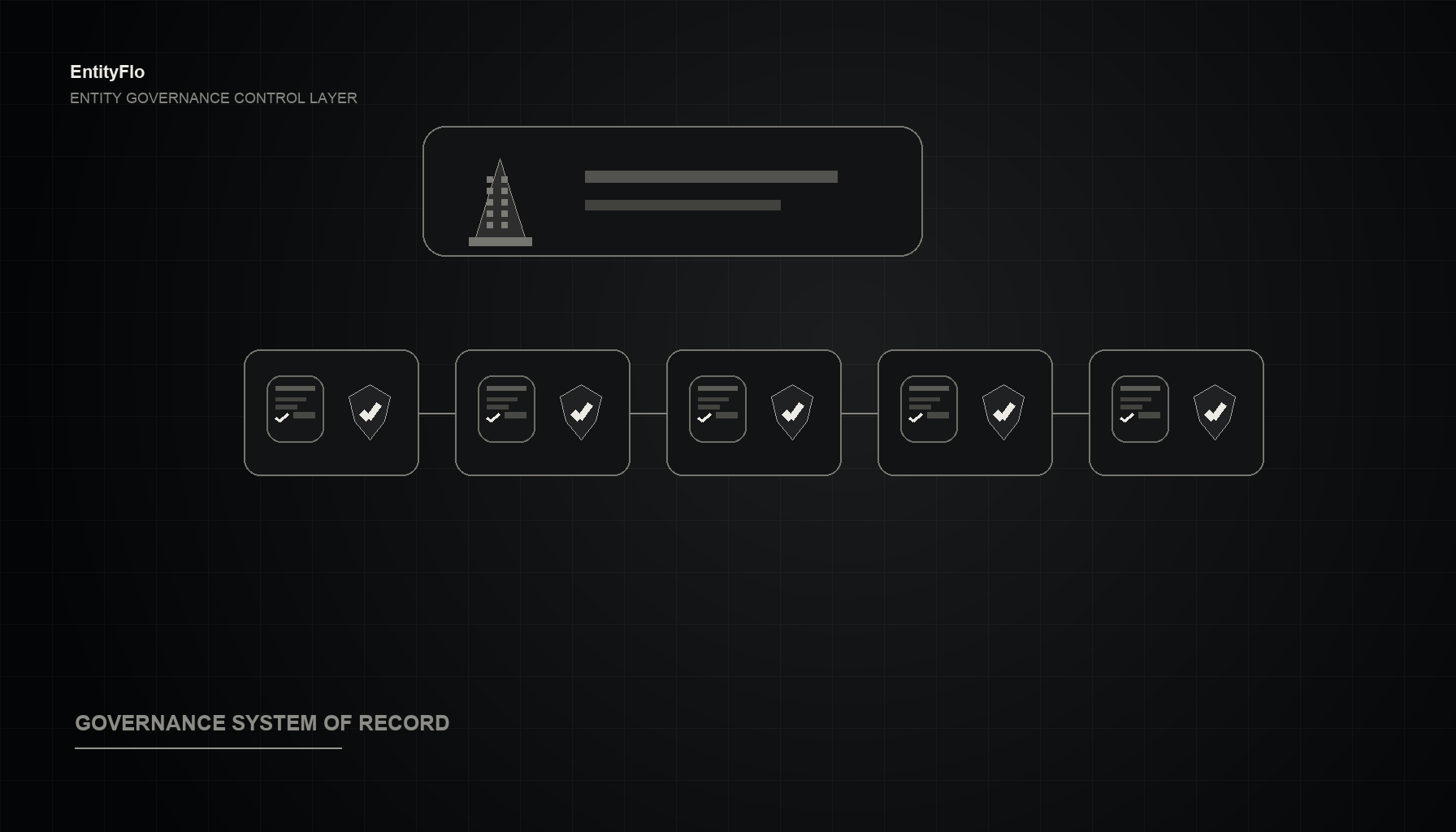
Private equity growth creates entity sprawl.
Every acquisition adds companies, directors, shareholders, trust or fund structures, bank signatories, insurance renewals, ASIC obligations, documents and local operating processes. At first, each portfolio company can manage its own records. Eventually, that creates a group-level problem: no one can see the full entity picture without chasing multiple teams, advisers and spreadsheets.
This guide explains how private equity teams can keep entity records under control as the portfolio grows.
Quick answer: what should PE teams track?
For each portfolio company and related entity, track:
- legal entity name and registration details
- jurisdiction and registered address
- directors, secretaries and officers
- shareholders, members and ownership percentages
- ultimate holding structure
- ASIC or registry deadlines
- annual review and filing status
- board and shareholder approvals
- key governing documents
- insurance, licences and renewals
- open compliance actions
- evidence for each change
The goal is not just to “store documents.” The goal is to know what is current, what changed, what is due and what still needs fixing.
Why portfolio entity management gets messy
The problem usually starts after the deal closes.
During diligence, everyone focuses on the transaction. After completion, governance records often stay inside:
- the target company’s folders
- external adviser portals
- old board packs
- finance spreadsheets
- email chains
- local management records
- ASIC or registry extracts
That may work for one company. It does not work across a growing portfolio.
The records to clean up after each acquisition
After a new portfolio company joins the group, create or verify:
Entity profile
Record the legal name, ACN or registration number, jurisdiction, registered office, principal place of business, tax numbers and review dates.
Officer records
Confirm current directors, secretaries and officers. Capture appointment dates, resignation dates, consent evidence and any filings required to align the registry.
Ownership records
Map the shareholder register, share classes, issued shares, transfers, options, convertible instruments and any indirect holding structures.
Governance documents
Store constitutions, shareholder agreements, board charters, trust deeds, investment documents, side letters and key approvals.
Filing and obligation calendar
Add annual reviews, registry deadlines, licence renewals, insurance renewals, tax dates and any deal-specific undertakings.
Evidence pack
Keep the source documents behind every change: resolutions, consents, transfer forms, filing receipts, minutes and signed agreements.
Common PE entity management failures
The platform team has no single view
Finance may know the reporting entities. Legal may know the directors. The company secretary may know the filings. Operations may know insurance. Nobody has the complete record.
Portfolio companies keep their own version
Local management may maintain records that do not match the fund or group view. This creates problems during refinancing, sale prep, audit or bolt-on acquisitions.
Director and ownership changes are not closed out
A deal decision is made, but the follow-through is incomplete: register update, ASIC filing, signed evidence, ownership chart and internal record do not all align.
Exit readiness starts too late
When a buyer asks for the entity pack, the team has to reconstruct years of decisions, filings and documents under pressure.
How to organise the portfolio record
A practical PE entity system should have three layers.
1. Portfolio view
This shows every entity, current status, ownership, open actions, filing dates and missing records across the portfolio.
2. Entity record
Each company has its own profile with officers, shareholders, documents, filings, obligations and history.
3. Action layer
Every gap becomes an action: who owns it, what evidence is needed, what filing is required, when it is due and when it was completed.
Without the action layer, the system becomes another document library.
How this differs from generic entity management content
This article is specifically about private equity and portfolio growth.
It should not compete with the main entity management software page. The main page explains the broad category. This page answers a specific PE problem: how to maintain control across acquired companies, SPVs and portfolio structures as the group grows.
It also differs from an ASIC checklist. ASIC is one part of the control system, not the whole portfolio record.
Where EntityFlo helps
EntityFlo gives private equity and investment teams one entity record across the portfolio.
That means:
- portfolio companies are visible in one place
- officers and shareholders are kept current
- ASIC and registry details can be reconciled
- documents and evidence attach to the entity they support
- filings and obligations become tracked actions
- legal, finance and compliance work from the same record
The benefit is not just cleaner administration. It is faster diligence, fewer record gaps, better exit readiness and less key-person risk.
Practical private equity checklist
For every portfolio company, run this check:
- Do we know the current directors and officers?
- Do we have consent and appointment evidence?
- Does the shareholder register match the ownership model?
- Do we know the annual review and filing dates?
- Are recent changes supported by resolutions or minutes?
- Are ASIC or registry details aligned with internal records?
- Are insurance and licence renewals tracked?
- Are key documents stored against the entity?
- Are open gaps assigned to an owner?
- Could we produce an entity pack quickly for diligence?
If the answer to any of those is no, the portfolio record needs work.
FAQ
What is entity management for private equity?
It is the process of maintaining accurate records, ownership, directors, documents, filings and obligations across portfolio companies, SPVs and fund-related entities.
Why does private equity need entity management software?
Because portfolio growth creates more entities, more filings, more directors, more ownership changes and more evidence to manage. Software helps keep the record current across the whole portfolio.
Is this the same as portfolio monitoring software?
No. Portfolio monitoring software usually tracks financial and operating performance. Entity management software tracks the legal entity record, governance evidence, filings and compliance obligations.
When should a PE firm move beyond spreadsheets?
When records are split across portfolio companies, advisers and internal teams, or when diligence, refinancing, exit prep or audits require entity information quickly.
How does EntityFlo support private equity portfolios?
EntityFlo centralises portfolio entity records, officers, shareholders, ownership, ASIC details, filings, documents, obligations and open actions in one platform.