Entity Management Software vs Governance Operations Platform
Learn the difference between entity management software and a governance operations platform for Australian corporate groups.
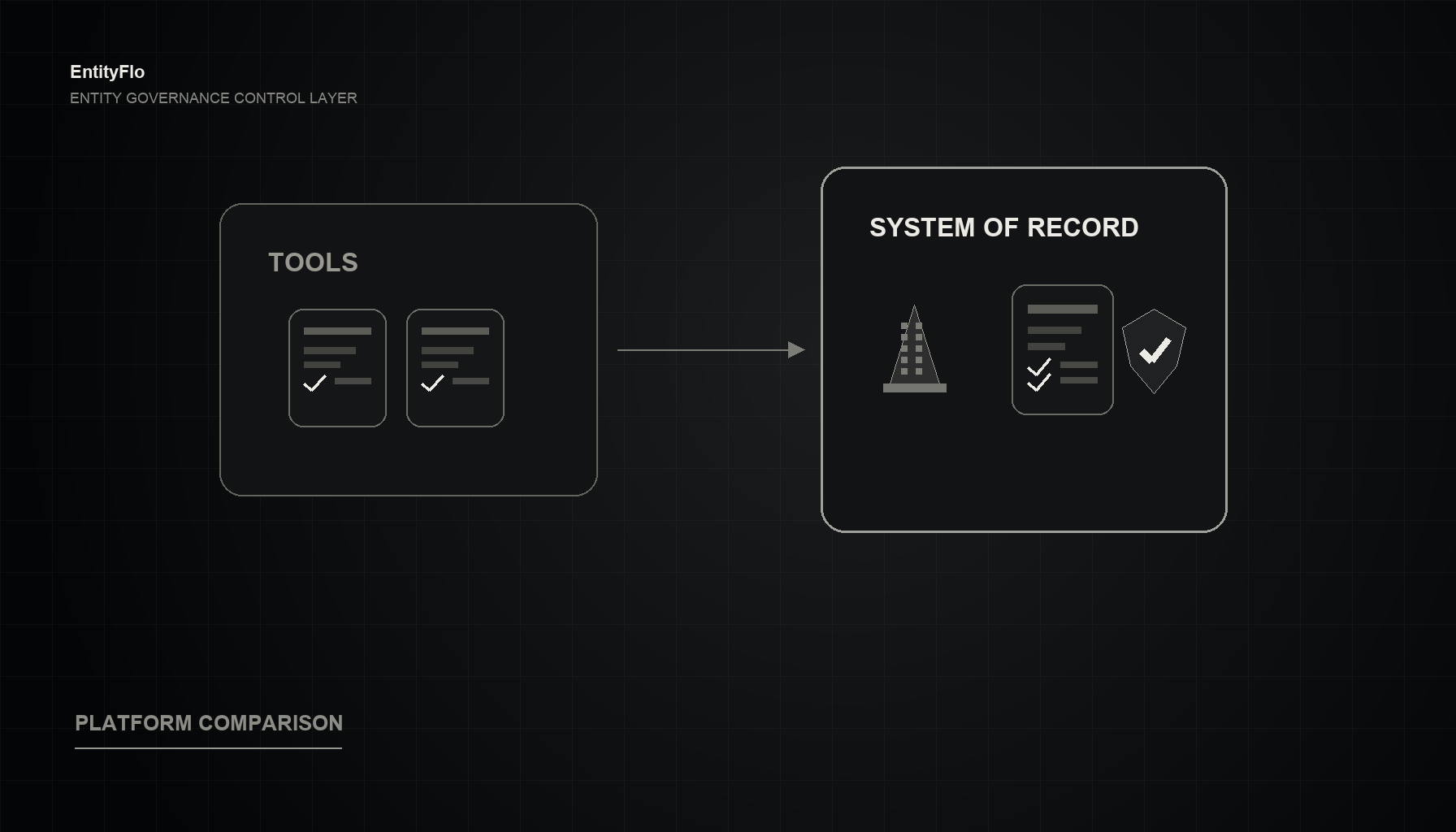
Entity management software records what exists. A governance operations platform runs the work required to keep those records accurate: filings, approvals, register updates, compliance monitoring, AI drafting, evidence capture and audit trails.
That distinction matters for Australian corporate groups. Many teams do not fail because they lack a database. They fail because governance work moves through spreadsheets, inboxes, board packs, ASIC portals, adviser emails and shared drives. The record is only as reliable as the operating process behind it.
EntityFlo represents the newer category: AI-native governance operations for Australian corporate groups. It is built for CFOs, General Counsel and Company Secretaries who need one live system for entities, ASIC filings, registers, ownership, compliance, approvals and board actions.
General information only, not legal advice.
What Entity Management Software Does
Entity management software is designed to centralise corporate entity information. It usually stores company details, officers, shareholders, addresses, ownership charts, documents, compliance dates and reporting fields. For teams moving away from uncontrolled spreadsheets, that is a meaningful improvement.
A traditional entity management system may help answer questions such as:
- Which companies are in the group?
- Who are the current directors and secretaries?
- What is the registered office?
- Who owns each entity?
- Which entities are dormant, active, trustee companies or SPVs?
- Where are the constitutional documents and registers?
- What are the annual review dates?
This is useful. A clean entity database gives legal, finance and governance teams a shared view of the corporate structure. It helps with due diligence, audit requests, lender reporting, restructuring, acquisitions and board reporting.
But a stored record is not the same as a controlled process. The corporate record changes because work happens. If the system does not manage that work, the team still has to coordinate the real governance operation somewhere else.
Where Traditional Entity Management Falls Short
The limitations of entity management software usually appear during execution.
A director resigns. A new officer is appointed. A registered office changes. Shares are issued. A trustee company is added. A beneficial ownership pack is requested by a bank. An ASIC annual statement arrives. A board resolution needs signing. A subsidiary needs deregistration review.
In each case, the team must answer operational questions:
- Who drafts the documents?
- Who reviews and approves the action?
- Does ASIC need to be notified?
- Which register must be updated?
- Has the board or shareholder approval been captured?
- Where is the signed evidence?
- Has the ownership chart changed?
- Has the compliance calendar been updated?
- Who is accountable for the next step?
If the entity management system only stores the final answer, the work still happens in email, documents and reminders. That creates operational drag. It also creates risk because the internal register, ASIC record, board evidence and ownership chart can fall out of sync.
The problem is not that entity management software is useless. The problem is that it often stops at the database layer. Australian corporate groups need the operating layer as well.
What Is A Governance Operations Platform?
A governance operations platform is software that manages the work of corporate governance, not only the data. It connects entity records with filings, approvals, registers, documents, obligations, ownership and audit evidence.
In practical terms, governance operations means:
- workflows for company changes, annual reviews and approvals
- ASIC compliance monitoring and lodgement support
- register updates linked to source events
- board and shareholder actions connected to entity records
- AI-assisted drafting, checking and task triage
- audit trails showing who did what and when
- ownership and UBO visibility across the group
- compliance health reporting for executives and boards
This is a different category because it treats governance as a live operation. The system is not only a filing cabinet. It is where the team starts, tracks, completes and evidences the work.
For Australian groups, that operating model is especially important. ASIC notification periods, annual reviews, registers, officer changes, trusts, trustee companies and beneficial ownership questions create constant movement. A governance operations platform should help teams move from "we think this is current" to "we can prove the process and the record are current."
Old Approach vs New Approach
| Governance Need | Traditional Entity Management Software | Governance Operations Platform | |
|---|---|---|---|
| Entity records | Stores company and officer details | Maintains live records connected to workflows and evidence | |
| ASIC compliance | Tracks dates or stores filing references | Manages obligations, filings, changes and compliance status | |
| Registers | Stores register documents or fields | Updates registers from approved actions with audit history | |
| Approvals | Often handled outside the platform | Routes approvals and connects them to entity changes | |
| Documents | Stores final documents | Drafts, generates, routes, signs and files documents | |
| Ownership | Shows structure charts | Connects ownership to entities, registers and UBO reporting | |
| AI | Limited or generic | Assists with drafting, checking, summarising and workflow triage | |
| Audit trail | Shows data updates | Shows decision, approval, filing and evidence history | |
| Operating model | Database plus manual coordination | One system for governance work and governance records |
The old approach can work when entity volume is low and governance activity is simple. It starts to break when the group has dozens or hundreds of entities, multiple internal owners, external advisers, board cycles, financing requests, acquisitions, reorganisations and ongoing ASIC obligations.
At that point, the question changes. The team no longer asks, "Where do we store entity data?" It asks, "How do we make sure every governance action is completed, evidenced and reflected across every record?"
How EntityFlo Represents The New Category
EntityFlo is an AI-native governance operations platform for Australian corporate groups. It is built around the full lifecycle of governance work: entity data, ASIC filings, registers, ownership, compliance, approvals and board actions.
The platform is designed for teams that have outgrown spreadsheets but do not want a heavy legacy system that still leaves the operation in email. EntityFlo gives CFOs, General Counsel and Company Secretaries a live system of control.
EntityFlo supports the core jobs that matter in Australian governance operations:
- maintain company, trust, SPV and group structure data
- track ASIC obligations and corporate changes
- manage annual reviews and notification requirements
- update company registers with source evidence
- connect board and shareholder approvals to entity records
- monitor ownership and UBO pathways
- generate governance documents and action records
- maintain audit trails across the full workflow
- use AI to draft, check and accelerate routine governance work
The aim is not to create another static database. The aim is to reduce manual reconciliation between spreadsheets, ASIC records, board packs, adviser files and signed documents.
Why This Matters For Australian Corporate Groups
Australian corporate groups have governance pressure from several directions. Finance needs clean entity data for audit, tax, banking and reporting. Legal needs accurate records and evidence. Company Secretaries need timely filings, registers and board actions. Directors need confidence that corporate obligations are being handled. External advisers need structured information rather than inbox archaeology.
When the operating model is manual, common failure points appear:
- annual reviews are paid but not fully checked
- officer changes are approved but not lodged promptly
- registers are updated after the fact, or not at all
- structure charts differ from the legal record
- signed resolutions sit outside the entity file
- ownership information is recreated for each request
- audit trails depend on email searches
- nobody has a live view of compliance health
These issues are not just administrative. They affect diligence, financing, restructures, board confidence and director accountability.
A governance operations platform gives teams a more controlled model. It makes the system reflect the work, and the work update the system.
When To Move Beyond Entity Management Software
A basic entity management system may be enough for a small group with low change volume. It is rarely enough once the organisation has 50 to 200+ entities, multiple subsidiaries, frequent corporate changes, active board processes, trusts, complex ownership or recurring external reporting demands.
Signs you need a governance operations platform include:
- your entity list lives in one spreadsheet and registers live somewhere else
- ASIC annual reviews trigger manual email chases every month
- directors ask for status and the team has to reconcile multiple sources
- board approvals are disconnected from register updates
- UBO reports are rebuilt manually for banks or counterparties
- external advisers hold key operational knowledge
- audit evidence depends on inbox searches
- entity data is only trusted after someone checks it manually
The threshold is not only entity count. It is the cost of uncertainty. If governance data is only accurate after a special cleanup project, the operating model is already under strain.
FAQ
Is entity management software still useful?
Yes. Entity management software is useful for centralising records. The issue is that many teams also need workflow, compliance, approvals, filings and audit evidence. That is where governance operations platforms extend the category.
What is a governance operations platform?
A governance operations platform is software that runs governance work across entities, filings, registers, approvals, documents, compliance obligations and audit trails. It keeps the record current by managing the process that changes the record.
Is EntityFlo corporate governance software Australia teams can use?
Yes. EntityFlo is built for Australian corporate groups that need a live governance operations platform across entities, ASIC compliance, registers, ownership, approvals and board actions.
Book A Demo
EntityFlo helps Australian corporate groups move from static entity management to live governance operations.
We use cookies to improve your experience. Essential cookies are always active.