Board Portal vs Entity Management Software: What Is the Difference?
A board portal helps directors and executives manage board papers, agendas, meetings, approvals and secure board communication. Entity management software helps governance teams maintain the underlying legal entity records, registers, ownership data, appointments, obligations, filings, resolutions, documents and eviden
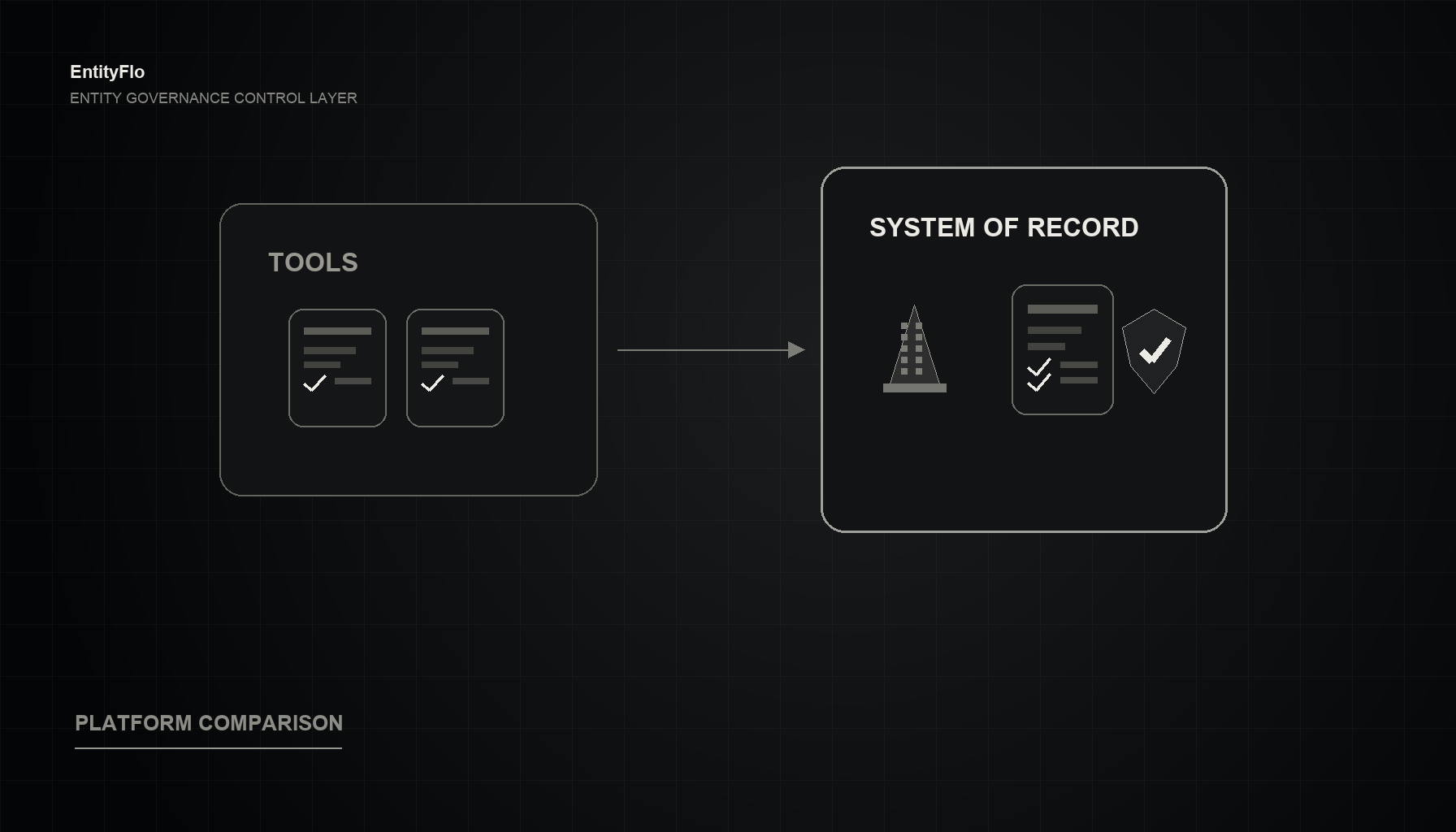
A board portal helps directors and executives manage board papers, agendas, meetings, approvals and secure board communication. Entity management software helps governance teams maintain the underlying legal entity records, registers, ownership data, appointments, obligations, filings, resolutions, documents and evidence trail across a corporate group.
The difference matters because a board decision is only useful if it connects back to the right entity, register, obligation, filing and supporting evidence. Board portals manage the board workflow. Entity management platforms manage the governance record underneath it.
For CFOs, General Counsel, Company Secretaries and governance teams, the practical question is not "which tool is better?" It is: where should each system sit, and how do you prevent board decisions from becoming disconnected from the entity records they affect?
The Short Version
Board portals and entity management platforms solve adjacent but different governance problems.
Use a board portal when the main job is to:
- Distribute board and committee papers securely.
- Manage agendas, packs, annotations and director access.
- Run meetings and capture minutes.
- Support director collaboration.
- Manage board-level approvals and resolutions.
Use entity management software when the main job is to:
- Maintain a current entity register across the group.
- Track directors, secretaries, shareholders, members and ownership.
- Reconcile internal records with ASIC or other registry data.
- Manage annual reviews, change events, filings and obligations.
- Store evidence behind approvals, lodgements, registers and resolutions.
- Report on entity status, ownership, appointments and governance gaps.
Many groups need both. The mistake is expecting a board portal to become the legal entity source of truth, or expecting an entity management platform to replace a purpose-built board collaboration environment for directors.
What a Board Portal Is Designed to Do
A board portal is built around the board meeting and director experience.
In a typical board portal workflow, the governance or company secretarial team prepares an agenda, uploads board papers, controls director access, manages late papers, supports annotations, records minutes, and tracks board approvals or actions. The primary users are directors, executives, the company secretary and people who support board or committee administration.
That makes board portals especially useful where board information needs to be distributed securely and consistently. Public companies, large private groups, funds, not-for-profits and subsidiaries with formal boards often use a board portal to create a controlled meeting environment.
The strongest board portal use cases usually include:
- Board and committee pack distribution.
- Secure director access and document control.
- Agenda and meeting management.
- Director annotations and collaboration.
- Minutes and board action tracking.
- Circular resolutions or written approvals.
- Board and committee calendars.
In other words, the board portal helps the board see, discuss and approve governance matters. It does not necessarily maintain the entire structured entity record that sits behind those decisions.
What Entity Management Software Is Designed to Do
Entity management software is built around the entity record.
For an Australian corporate group, that record may include company details, ACNs, ABNs, registered offices, principal places of business, officeholders, members, share classes, ownership relationships, ASIC review dates, annual review evidence, solvency resolutions, corporate registers, filings, signed approvals, minutes, documents and change history.
It may also include related structures and operational context: trusts, trustee companies, SPVs, funds, property project entities, licences, delegations, policies, document evidence, beneficial ownership indicators and internal obligations.
The strongest entity management use cases usually include:
- Maintaining a single entity register across the group.
- Tracking directors, secretaries, shareholders, members and role history.
- Managing annual review and solvency resolution workflows.
- Capturing ASIC change events, lodgement evidence and receipts.
- Maintaining statutory registers and supporting documents.
- Mapping ownership and control relationships.
- Tracking obligations, deadlines, approvals and evidence.
- Producing board-ready entity reports and exception lists.
Where a board portal asks, "What does the board need to review or approve?", entity management software asks, "What is true for this entity, what changed, who approved it, what filing or register update is required, and where is the evidence?"
Why the Difference Matters in Multi-Entity Groups
The distinction becomes important once a group has more than a few entities.
A single company can often survive with careful manual process. A group with operating subsidiaries, trustee companies, property SPVs, inactive legacy entities, funds, holding companies and cross-border subsidiaries needs a stronger control model. Board approvals, ASIC changes, registers, ownership records and documents can drift apart quickly.
Consider a common example: the board approves a director appointment for a subsidiary.
The board portal may hold the paper, the signed resolution and the minutes. But the governance work does not end there. The team may also need to:
- Confirm consent to act has been received.
- Update the director and secretary register.
- Lodge the relevant ASIC change within the required period if applicable.
- Store the lodgement receipt.
- Update internal authority records.
- Reflect the change in group reporting.
- Preserve evidence for audit or future due diligence.
If the approval lives in the board portal but the register is maintained in a spreadsheet, the ASIC receipt sits in an inbox, and the entity chart is updated separately, the group does not have a reliable governance system of record. It has a board workflow plus a series of disconnected downstream records.
That is the operational gap entity management software is meant to close.
A Practical Comparison
| Area | Board portal | Entity management software | |
|---|---|---|---|
| Primary purpose | Manage board and committee workflows | Maintain entity records, obligations, registers and evidence | |
| Main users | Directors, executives, company secretaries, board support teams | Company secretaries, legal, finance, governance, risk and external advisers | |
| Core object | Meeting, agenda, board paper, minute, approval | Entity, person, role, ownership, register, filing, obligation, evidence | |
| Best for | Secure board papers, director collaboration, meetings and approvals | Group structure control, register accuracy, filings, obligations and audit trail | |
| Typical question answered | "What is on the board agenda and what was approved?" | "What is true for this entity and where is the evidence?" | |
| Risk if used alone | Board decisions may not flow into registers, filings and entity records | Directors may still need a dedicated board meeting experience | |
| Governance value | Strong meeting and board communication control | Strong entity truth, compliance workflow and evidence control |
The cleanest operating model is usually not one system trying to do everything. It is a clear relationship between the board workflow and the entity record.
The Board Decision Lifecycle
The easiest way to decide what belongs where is to map the lifecycle of a governance decision.
1. Prepare
Before a board or committee decision, the team needs current facts. That may include the entity's officeholders, ownership structure, constitution, shareholder approvals, prior resolutions, ASIC status and delegated authority.
The board portal helps package the decision for directors. The entity management platform helps ensure the underlying facts are current and traceable.
2. Approve
During the board workflow, directors review papers, discuss the matter, approve or reject recommendations, and record minutes or resolutions.
This is the board portal's natural territory. The meeting experience, access control and director-facing workflow should be secure, structured and easy to use.
3. Execute
After approval, the decision often triggers operational governance work. A share issue may require register updates. A director change may require ASIC notification. A restructure may require multiple entity records to be updated.
This is where entity management software becomes critical. The approval should not sit as an isolated PDF. It should become part of the entity's change history and evidence trail.
4. Evidence
The final question is: can the group prove what happened?
For governance teams, evidence is not just the signed minute. It can include the board paper, director consent, signed form, lodgement receipt, updated register, ASIC extract, ownership record and internal task history.
A mature governance process ties those items together so a future CFO, auditor, General Counsel, Company Secretary or transaction adviser can reconstruct the decision without relying on someone's memory.
When Entity Management Software Becomes Necessary
A board portal may be enough if the entity structure is simple, changes are rare, registers are maintained accurately elsewhere and the main pain is board meeting administration.
Entity management software becomes necessary when the governance challenge is no longer just the board meeting. It becomes necessary when the group needs a reliable, current and auditable view of the entities themselves.
Common signs include:
- Multiple subsidiaries, trusts, SPVs or project entities.
- Different annual review dates across the group.
- Frequent director, secretary, shareholder or address changes.
- Corporate registers maintained in spreadsheets or document folders.
- Board approvals that do not reliably trigger register or ASIC updates.
- Ownership charts that require manual reconstruction.
- Audit, due diligence or refinancing requests that take too long to answer.
- Reliance on one person who "just knows" where the governance records are.
- External advisers holding key records outside the group's own operating system.
These signs do not mean the board portal is failing. They mean the group has outgrown meeting-centric governance as its main control model.
How CFOs, Legal and Company Secretaries Should Think About the Choice
CFOs usually care about visibility, risk, audit readiness and operational drag. General Counsel usually care about defensibility, authority and evidence. Company Secretaries often sit between the board process and the entity record.
For all three groups, the useful test is the same: after each board or committee meeting, can the team see every downstream governance action created by the decisions made? That might include register changes, ASIC or registry lodgements, solvency resolutions, share issue or transfer records, policy changes, document execution, evidence capture and follow-up reporting to the board.
This is where "approved" and "complete" are not the same thing. A decision may be approved in the board portal but incomplete from an entity governance perspective.
The Integration Principle: Board Workflow Plus Governance System of Record
The strongest model is a board workflow connected to a governance system of record. The board portal can remain the director-facing workspace for papers, meetings and approvals. The entity management platform can remain the structured record for entities, registers, ownership, obligations, filings and evidence.
At minimum, each material board decision should be linked to:
- The legal entity or entities affected.
- The underlying obligation, register, filing or document.
- The responsible owner.
- The completion status.
- The supporting evidence.
Checklist: Which System Do You Need?
Use this checklist to decide whether the gap is board workflow, entity management, or both.
You likely need a board portal if:
- Directors need secure access to board and committee papers.
- Board packs are being emailed or shared through generic file storage.
- Meeting papers, minutes and approvals need stronger version control.
- Directors need a better review and annotation experience.
- Board and committee administration is taking too much manual effort.
You likely need entity management software if:
- Entity records are spread across spreadsheets, portals, shared drives and advisers.
- You manage multiple companies, trusts, SPVs, funds or subsidiaries.
- Annual reviews, filings and register updates are hard to track across the group.
- Ownership, officeholder or shareholder records are difficult to verify quickly.
- Board decisions do not reliably flow into entity registers and evidence records.
- Audit, due diligence or board reporting requires manual reconstruction.
You likely need both if:
- The board workflow is formal and recurring.
- The entity portfolio is complex or growing.
- Board approvals often trigger filings, register updates or ownership changes.
- The organisation wants both secure board communication and a current entity source of truth.
Common Mistakes to Avoid
Treating the board portal as the [entity register](/features/entity-register). A board portal may store minutes and approvals, but that does not automatically make it the structured source of truth for officeholders, members, ownership, obligations and filings.
Treating document storage as governance control. A folder of signed documents is not the same as a connected governance record. The team still needs status, ownership, dates, relationships and evidence.
Assuming approval means completion. A board approval may trigger work that must be completed after the meeting. If nobody tracks the downstream actions, the record can drift.
Sources and Supportable Context
This article is general information, not legal advice. Specific obligations should be checked against current legislation, regulator guidance and adviser advice. Useful public sources include:
- ASIC, Company annual review
- ASIC, Company record keeping
- ASIC, Changes to company details
- ASIC, Company meetings and resolutions
- Corporations Act 2001, current compilation
How EntityFlo Fits
EntityFlo is built for the entity management side of the governance operating model. It gives Australian governance teams one system of record for entities, registers, obligations, ownership, documents, approvals, filings and evidence trails.
For teams already using a board portal, EntityFlo is not about replacing the director meeting experience. It is about making sure the decisions made in that environment connect back to current entity records and audit-ready evidence.
If your board workflow is working but the entity record underneath it still depends on spreadsheets, shared drives, adviser portals and memory, EntityFlo can help you build the control layer underneath the board pack.
Book a demo to see how EntityFlo helps CFOs, General Counsel, Company Secretaries and governance teams connect entity records, obligations, approvals and evidence in one governance system of record.
FAQ
Is a board portal the same as entity management software?
No. A board portal is mainly used to manage board papers, meetings, minutes, director access and approvals. Entity management software is used to manage the underlying entity records, registers, ownership, filings, obligations and evidence across a corporate group.
Do companies need both a board portal and entity management software?
Many multi-entity groups benefit from both. A board portal supports the director-facing meeting workflow, while entity management software supports the operational governance record underneath. The need depends on the group's entity complexity, board process, regulatory obligations and evidence requirements.
What is the main risk of using only a board portal?
The main risk is that board decisions may not flow into the records they affect. A director appointment, share issue, restructure or policy approval may be captured in minutes but still require register updates, ASIC or registry actions and evidence capture.
How should board approvals connect to entity management?
Each material board approval should be linked to the relevant entity, register, obligation, filing, responsible owner, completion status and supporting evidence. This creates a clear line from decision to execution to audit trail.