The RegistryConnect Revolution: Why "Digital Filing" Is No Longer Compliance
ASIC's RegistryConnect program is shifting compliance from passive filing to active data reconciliation. If your entity management system doesn't talk to the ASIC ledger in real-time, you aren't just inefficient—you are non-compliant.
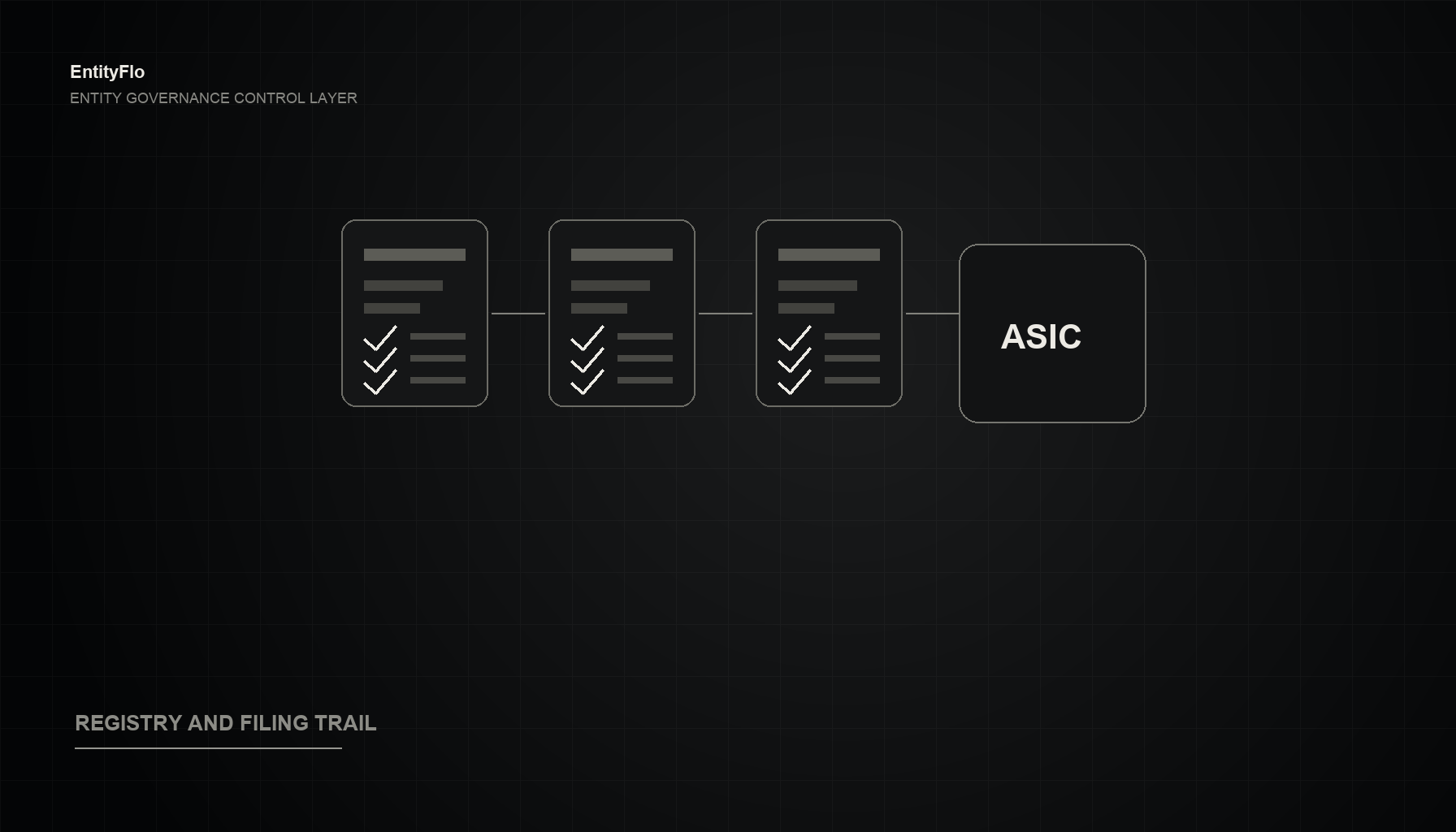
The Governance Gap Is Widening
For decades, the "Manual Tax" was a hidden cost of doing business in Australia. Large corporate groups—managing $100M to $7B in assets—have run on a "Passive Storage" model. An officer changes, a resolution gets signed, a PDF gets tucked into a folder. Eventually, someone lodges it with ASIC.
This model assumes the record is the truth. It isn't.
With the launch of ASIC's RegistryConnect program, the regulator is shifting toward active enforcement. Compliance is no longer a snapshot—it's a continuous, reconciled stream of data. If your internal entity management system doesn't talk to the ASIC ledger in real-time, you aren't just inefficient. You are non-compliant.
From MBR to RegistryConnect: The Shift to Data Integrity
The $530M Modernising Business Registers (MBR) program was a lesson in over-complexity. Launched from the 2018-19 Budget, it aimed to merge the Australian Business Register and 31 ASIC registers onto a single platform under the ATO. It was stopped in August 2023 after an independent review exposed scope creep, contractor blowouts, and COVID disruption.
Its successor, RegistryConnect, is leaner, faster, and more dangerous for messy corporate groups.
The core mission is data stabilisation. The 2025-26 Federal Budget locked in significant funding, and ASIC is now executing across three fronts:
- Linking Director Identification Numbers (Director IDs) directly to company seats on the register.
- Mandating stronger authentication to validate users without exposing private details.
- Strengthening data quality and integrity across 3.4 million companies and 2.8 million business names—registers that processed 343 million searches and 3.1 million updates in the past year alone.
By hard-coding Director IDs into the companies register and pushing toward Ultimate Beneficial Ownership (UBO) transparency, ASIC is building a verified identity graph of Australian business. The gap between "what's in your spreadsheet" and "what's on the ledger" is now a liability, not an inconvenience.
The Deterministic Moat
Most GRC tools are digital filing cabinets. They store what you give them. But in a RegistryConnect environment, storage is a liability if the data is dirty.
EntityFlo was built as active infrastructure. We run a Deterministic Governance Engine—a system that doesn't just store data but audits it against hard-coded jurisdictional rules.
The Scan. Continuous reconciliation with ASIC's register to surface discrepancies before they become breaches.
The Find. Identifying missing Director IDs, unexecuted Consent to Act forms, or stale officeholder records across 500+ entities.
The Fix. Automated resolution drafting that closes a breach in 30 seconds—not 30 days.
This is the difference between passive compliance and deterministic certainty. One reacts to audits. The other eliminates the need for them.
Reclaiming the 15% Knowledge Tax
Beyond risk, there's a cost-of-talent problem. Our data shows CFOs and General Counsels at billion-dollar groups lose roughly 15% of their productive week to governance friction—chasing signatures, reconciling spreadsheets, prepping for audits.
RegistryConnect makes this manual chase impossible to sustain. ASIC's new registry search, upgraded mainframe, and incoming digital lodgement services are raising the bar on what "compliant" looks like. Groups still running on spreadsheets and shared drives will feel it first.
By moving to a deterministic system, groups are cutting governance admin by up to 95%, freeing their most expensive people to focus on strategy instead of forms.
What This Means for You
If you're a CFO, General Counsel, or Company Secretary managing a complex corporate group in Australia, the question isn't whether RegistryConnect will affect you. It already has.
The regulator is moving. The infrastructure is being built. The only variable is whether your entity data is clean enough to survive the reconciliation.
Stop paying the Knowledge Tax. Start demanding precision.
Further Reading:
- ASIC: Stabilising and Uplifting Business Registers
- ASIC Updates Information Available Through Purchased Extracts
Nathan Carroll is the founder and CEO of [EntityFlo](https://entityflo.com). With multiple successful exits and experience scaling SaaS companies globally, Nathan is building the future of corporate governance for Australian businesses. [Connect on LinkedIn](https://linkedin.com/in/nathan-carroll-32b98231).