What is Entity Management Software? The Complete Guide for Australian Businesses (2026)
Entity management software centralises corporate registers, ASIC compliance, and governance for Australian businesses managing multiple entities. Learn what it does, who needs it, and what to look for.
Introduction
If you're a CFO, Company Secretary, or General Counsel managing more than a handful of corporate entities, you already know the problem: endless spreadsheets, manual ASIC filings, scattered documents, and the creeping anxiety that something has slipped through the cracks.
Most Australian businesses running a group structure — whether it's a private equity portfolio, a property group with multiple SPVs, or a corporate group with subsidiaries across states — are still managing entity compliance the hard way. The cost isn't just time. It's regulatory risk, audit exposure, and the kind of errors that lead to ASIC penalties or board embarrassment.
Entity management software was built to solve exactly this. In this guide, we'll cover what entity management software is, what it actually does, who needs it, and what to look for when evaluating platforms — with a focus on what matters for Australian businesses in 2026.
What is Entity Management Software?
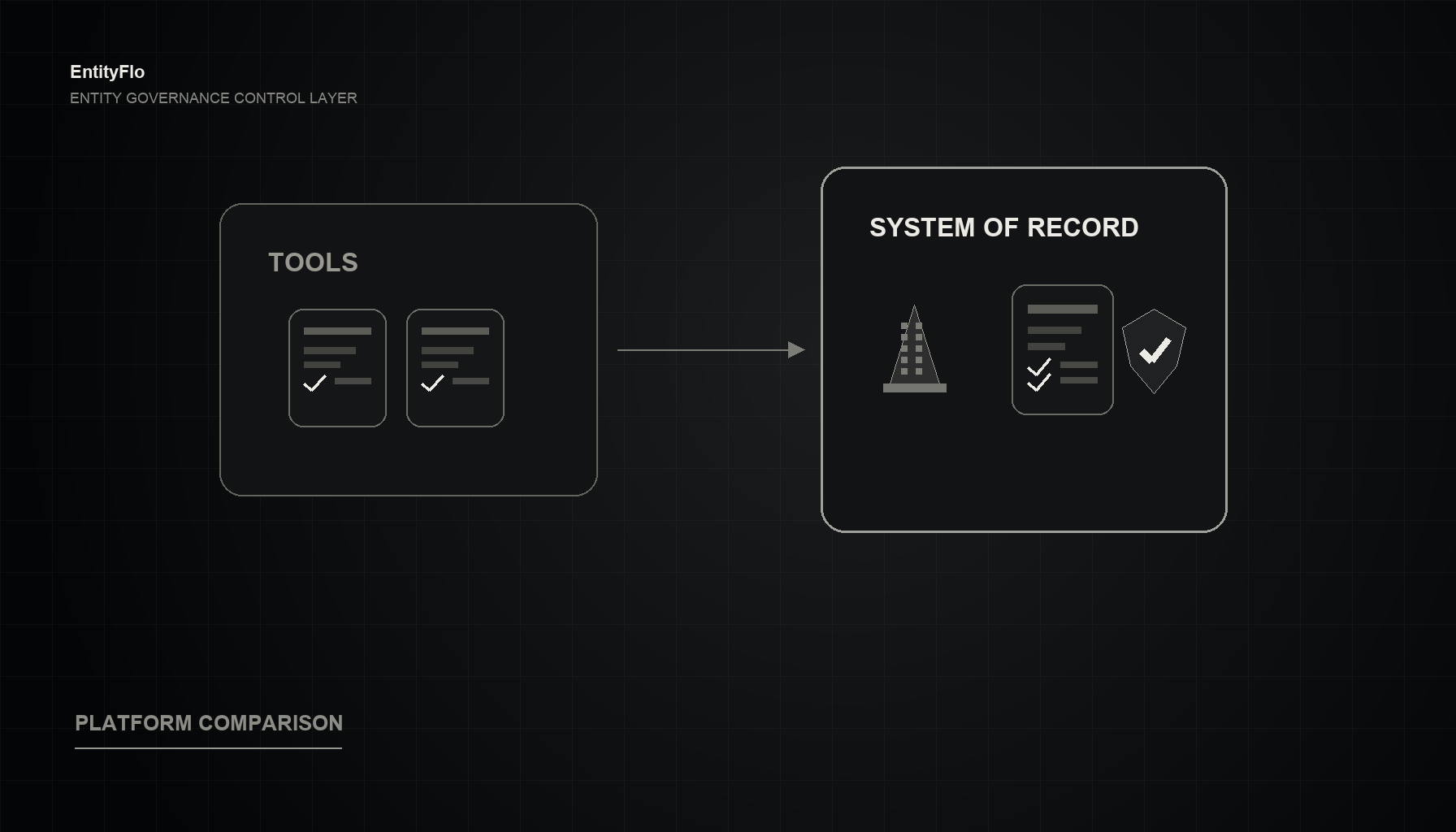
Entity management software is a dedicated platform that centralises the governance, compliance, and administration of corporate entities — including subsidiaries, trusts, joint ventures, and special purpose vehicles — within a single system of record. It replaces fragmented spreadsheets, shared drives, and paper-based registers with a structured, auditable environment where every entity's details, documents, filings, ownership structure, and governance activity are maintained in real time.
At its core, entity management software solves a data integrity and workflow problem. When a business manages five, ten, or fifty entities, critical information — director details, share registers, ASIC filing deadlines, constitutional documents, board resolutions — lives in different places and is owned by different people. Updates happen in isolation. Errors compound. Deadlines are missed.
Entity management software brings all of that into one place, automates routine compliance tasks (such as ASIC annual review lodgements and officer change notifications), and creates a complete, searchable audit trail of every action taken across the group.
Who uses it? Primarily in-house legal and governance teams, Company Secretaries, CFOs, and General Counsels at mid-market and large Australian businesses. It's also used by private equity firms, family offices, and professional services firms (such as accounting and law firms) that manage entity portfolios on behalf of clients.
Entity management software sits at the intersection of corporate law compliance, governance best practice, and operational efficiency — making it an essential tool for any organisation where getting entity administration wrong carries real legal and financial consequences.
What Does Entity Management Software Actually Do?
The day-to-day functions of entity management software cover the full lifecycle of managing corporate entities. Here's what a purpose-built platform handles:
Corporate Register Maintenance
Every Australian company is required to maintain accurate registers — including a register of members, a register of directors and secretaries, and a register of charges. Entity management software maintains these registers digitally, keeping them current as changes occur and making them instantly accessible for audits, due diligence, or regulatory review.
ASIC / Registry Compliance and Filings
One of the highest-value functions. The platform tracks statutory deadlines — annual reviews, director changes, registered office updates, share allotments — and automates or prompts the preparation and lodgement of forms directly with ASIC. This eliminates the manual calendar-watching that leads to late filings and penalties.
Ownership and UBO Mapping
For groups with complex structures — including trusts, holding companies, and cross-shareholdings — entity management software maps the full ownership chain and identifies Ultimate Beneficial Owners (UBOs). This is increasingly important for AML compliance and meets growing regulatory expectations around transparency of ownership.
Document Management
Constitutional documents, share certificates, executed resolutions, executed agreements, and correspondence are stored in a structured Document Vault, linked directly to the relevant entity. Version control and access permissions ensure the right people see the right documents.
Governance Workflows
Drafting and circulating board resolutions, recording minutes, obtaining electronic signatures, and managing approval workflows — all within the platform. This replaces the email-and-Word-document process that most teams still rely on.
Audit Trails
Every change — to a register, a document, an officer record — is logged with a timestamp and user attribution. This creates an immutable audit trail that satisfies both internal governance requirements and external regulatory scrutiny.
Reporting and Dashboards
A multi-entity dashboard gives governance teams a real-time view across the entire group — upcoming filing deadlines, compliance status, officer details, ownership summary — without having to open multiple files or request updates from different departments.
Who Needs Entity Management Software?
Entity management software isn't just for large ASX-listed companies. The tipping point for most organisations is managing more than four or five entities — that's where manual approaches start to break down and the compliance risk becomes material.
Corporate Groups with 5+ Subsidiaries
Any operating group with a holding company and multiple subsidiaries faces a compounding compliance burden. Each subsidiary has its own ASIC obligations, its own officers, its own documents. Entity management software provides a single control centre for the entire group.
Private Equity and Fund Managers
PE firms typically manage multiple portfolio companies, each with its own legal structure, capitalisation table, and governance requirements. Entity management software supports the full investment lifecycle — from acquisition due diligence to exit — with clean records and audit-ready documentation.
Family Offices
Family offices often hold assets across a mix of companies, trusts, and investment vehicles, sometimes spanning multiple generations and jurisdictions. Maintaining accurate records of who owns what — and meeting reporting obligations for each vehicle — is exactly the kind of complex, ongoing task that entity management software is designed to handle.
Property Groups with Multiple SPVs
Property developers and investors commonly create a separate Special Purpose Vehicle (SPV) for each project or asset. Managing registers, loan agreements, and compliance across 10, 20, or 30 SPVs manually is both time-consuming and error-prone.
In-House Legal and Governance Teams
Any organisation where a Company Secretary, Head of Legal, or in-house governance team is responsible for entity compliance across the group will see immediate benefit. The software frees them from administrative overhead and lets them focus on higher-value governance work.
Entity Management Software vs. Spreadsheets: Why It Matters
Most Australian businesses start managing their entity portfolio in spreadsheets. It works — until it doesn't.
The Compliance Risk Is Real
ASIC penalties for late or incorrect filings are not trivial. A failure to notify a director change within 28 days, or to lodge an annual review on time, can result in administrative penalties and, in more serious cases, regulatory scrutiny. When your compliance calendar lives in a spreadsheet owned by one person, every holiday, resignation, or inbox overflow is a filing risk.
Audit Trail Gaps Create Exposure
Spreadsheets have no native audit trail. If a register is updated, there's no record of who changed what, when, and why. In a due diligence process, an investor or acquirer will ask for exactly this. In a regulatory inquiry, the absence of it is a problem.
Version Control Is a Structural Weakness
Which version of the share register is current? Is the director's address on file the same one submitted to ASIC? With documents spread across shared drives and email threads, version conflicts are common. Entity management software enforces a single source of truth.
The Hidden Cost of Manual Work
A Company Secretary managing 20 entities on spreadsheets might spend 30–40% of their time on data entry, status chasing, and document retrieval. At market rates for qualified governance professionals in Australia, that's a significant cost — one that doesn't show up on a spreadsheet comparison but absolutely shows up in salary and opportunity cost.
Scalability Breaks Down
Adding a new entity to a spreadsheet-based system means duplicating tabs, updating cross-references, and hoping nothing breaks. In entity management software, onboarding a new entity is a structured, templated process — taking minutes, not days.
The question isn't whether spreadsheets can technically hold entity data. They can. The question is whether they can do so reliably, at scale, with the audit trail and compliance automation that Australian regulatory expectations now demand. The answer, for most organisations managing more than a handful of entities, is no.
Key Features to Look for in Entity Management Software
Not all entity management platforms are equal. When evaluating options for an Australian business, use this checklist:
- ✅ ASIC / Regulatory Integration — Can the platform sync directly with the ASIC registry? Does it auto-populate filing forms and track lodgement deadlines? This is non-negotiable for Australian teams.
- ✅ Comprehensive Audit Trail — Every action should be logged: who made the change, what was changed, and when. Look for immutable logs that can be exported for external review.
- ✅ UBO / Beneficial Ownership Mapping — The platform should be able to visualise and document the full ownership chain across complex group structures, including trusts and cross-shareholdings.
- ✅ Document Automation — Ability to generate standard governance documents (resolutions, minutes, consent forms) from templates, with e-signature support.
- ✅ Multi-Entity Dashboard — A single view across all entities in the group — compliance status, upcoming deadlines, officer details — without having to drill into each record individually.
- ✅ Role-Based Access Control — Different team members need different levels of access. A board director shouldn't see the same view as an admin user. Look for granular, auditable permission settings.
- ✅ Australian Data Sovereignty — For Australian businesses, particularly those in regulated industries, data hosting location matters. Confirm that data is stored in Australian data centres and that the vendor meets applicable Australian privacy obligations.
- ✅ Integrations — Does the platform connect with your accounting software (Xero, MYOB), your legal practice management tools, or your document signing platform (DocuSign, Adobe Sign)? Integration reduces double-handling and keeps records consistent across systems.
- ✅ Scalability — Can the platform grow with you? Whether you're managing 5 entities today or 50 in three years, the architecture should handle it without a rip-and-replace.
- ✅ Local Support — Australian-based customer support that understands ASIC, the Corporations Act, and local governance practice is a practical advantage when you need help quickly.
How EntityFlo Approaches Entity Management
EntityFlo is an Australian-built entity management platform designed specifically for the ANZ mid-market — companies managing between five and fifty entities with in-house governance teams who don't have the luxury of a large dedicated compliance department.
The platform is built around a few core design principles:
ASIC Registry Sync. EntityFlo connects directly with ASIC to pull current entity data, track filing deadlines, and support direct lodgement of standard forms. Compliance calendars are automatically generated from registry data, not manually maintained.
Entity 360 Dashboard. Every entity in the group gets a complete 360-degree view — officers, shareholders, documents, filing history, upcoming obligations, and governance activity — in a single screen. The group-level dashboard aggregates this across the entire portfolio.
Governance Hub. Board resolutions, minutes, consent forms, and approval workflows are managed within the platform, with e-signature support and version control built in.
UBO and Ownership Mapping. EntityFlo visualises the full ownership structure across the group, identifies ultimate beneficial owners, and supports the documentation requirements that come with AML obligations and investor due diligence.
AI-Powered Compliance Alerts. The platform uses AI to surface upcoming obligations, flag anomalies in entity records, and prompt action before deadlines become penalties.
EntityFlo is purpose-built for the Australian regulatory environment — not adapted from a UK or US product. That distinction matters when ASIC compliance is the core use case.
Frequently Asked Questions
What is entity management?
Entity management is the ongoing process of maintaining accurate, compliant, and up-to-date records for each legal entity within an organisation — including companies, trusts, partnerships, and joint ventures. It covers the maintenance of statutory registers, tracking of regulatory obligations (such as ASIC filings), management of corporate documents, and governance activities like board resolutions and officer changes. For businesses managing multiple entities, entity management is a critical governance function that carries real legal obligations under the Corporations Act 2001.
What is the difference between entity management and company secretarial software?
The terms are often used interchangeably, but there is a distinction. Company secretarial software typically focuses on the tasks performed by a Company Secretary — drafting resolutions, managing meetings, maintaining statutory registers, and handling ASIC filings. Entity management software is broader: it encompasses company secretarial functions but also includes multi-entity ownership mapping, group-level dashboards, UBO tracking, and the kind of governance workflow automation that spans an entire corporate group. Entity management software is the more complete term for platforms designed to manage portfolios of entities, not just a single company.
Do small businesses need entity management software?
If a business operates as a single company with straightforward compliance needs, a dedicated entity management platform is likely unnecessary — a competent bookkeeper or accountant can handle the annual ASIC review and basic record-keeping. However, once a business begins adding subsidiaries, trusts, or investment vehicles — typically at the three to five entity mark — the complexity increases significantly, and the risk of manual error becomes material. For businesses in that range and above, entity management software typically pays for itself quickly in time saved, penalties avoided, and audit-readiness maintained.
What is a corporate register?
A corporate register (also called a statutory register) is the official record a company is required by law to maintain under the Corporations Act 2001. Australian companies must keep several registers, including: a register of members (shareholders), a register of directors and secretaries, and a register of charges. These records must be kept accurate and current, and are required to be available for inspection. In an entity management platform, these registers are maintained digitally and updated in real time as changes occur.
What is a beneficial owner / UBO?
A beneficial owner (often referred to as an Ultimate Beneficial Owner, or UBO) is the natural person who ultimately owns or controls a legal entity, even if that ownership or control is exercised through a chain of other entities, trusts, or nominees. For example, if a trust holds shares in a company, the UBO is the individual who benefits from that trust — not the trustee or the trust itself. Identifying UBOs is a requirement under Australian anti-money laundering (AML) legislation for certain regulated entities and is increasingly expected as a standard governance disclosure. Entity management software maps ownership chains to identify and document UBOs across complex group structures.
How much does entity management software cost in Australia?
Pricing for entity management software in Australia varies widely depending on the number of entities managed, the feature set required, and the vendor. Platforms targeted at professional services firms (accountants and solicitors managing client entities) may charge per entity or per portfolio. Platforms designed for in-house teams at mid-market corporates typically offer subscription pricing based on entity count or user seats, ranging from a few hundred dollars per month for small groups to several thousand per month for large portfolios with advanced features. Most vendors offer tiered plans and will provide a tailored quote based on your group's specific requirements. Free trials and demos are commonly available.
What happens if I miss an ASIC filing?
ASIC imposes administrative penalties for late lodgements. As of 2026, late fees apply automatically for filings submitted after the statutory deadline, and the penalty increases the longer the filing remains outstanding. In addition to financial penalties, persistent non-compliance can result in a company being flagged as non-compliant on the ASIC register, which can affect the company's ability to obtain finance, enter contracts, and pass due diligence checks. In serious cases, ASIC has the power to deregister a company for failure to comply with lodgement obligations. Entity management software addresses this risk by maintaining automated compliance calendars and providing advance alerts before deadlines fall due.
Is my data safe in entity management software?
Data security is a legitimate concern, particularly for corporate governance data that may include sensitive ownership information, board decisions, and confidential documents. When evaluating entity management software, look for platforms that: (1) host data in Australian data centres, (2) comply with the Australian Privacy Act and relevant state legislation, (3) use enterprise-grade encryption at rest and in transit, (4) support role-based access controls and multi-factor authentication, and (5) maintain SOC 2 or equivalent security certifications. Ask prospective vendors directly about their data hosting arrangements, incident response procedures, and backup and recovery policies.
What is the difference between entity management software for accountants vs. in-house teams?
Entity management platforms tend to serve two distinct markets, and the product design reflects that. Accountant-focused platforms (such as those used by accounting and legal practices) are typically designed around managing multiple client portfolios — the focus is on high-volume, standardised compliance tasks, billing integration, and client portal access. In-house team platforms are designed for a single corporate group — the focus is on cross-entity visibility, governance workflow, UBO mapping, board-level reporting, and integration with the company's own financial and legal systems. In-house platforms tend to offer more sophisticated group dashboards, more granular audit trails, and deeper ownership mapping. EntityFlo is built specifically for in-house governance teams at mid-market Australian companies.
Conclusion
Entity management software isn't a nice-to-have for Australian businesses managing a group structure — it's infrastructure. The compliance obligations under the Corporations Act are real, the penalties for non-compliance are material, and the operational cost of managing entities manually compounds as your portfolio grows.
If you're managing five or more entities on spreadsheets, the question isn't whether to move to a purpose-built platform — it's how quickly you can make the switch.
EntityFlo is designed specifically for mid-market Australian businesses that need a complete, ASIC-integrated entity management solution without the complexity and cost of enterprise-grade platforms built for a different market.
[Book a demo with the EntityFlo team →](https://entityflo.com/demo)
Nathan Carroll is the founder and CEO of EntityFlo — Australia's entity management platform for mid-market corporate groups. EntityFlo centralises governance, compliance, and ASIC filings for businesses managing 5–50 entities. [Connect on LinkedIn](https://linkedin.com/in/nathan-carroll-32b98231).