How CFOs Manage Subsidiary Governance Across a Corporate Group
Subsidiary governance is the system a corporate group uses to keep every controlled entity accurate, compliant, visible and decision-ready.
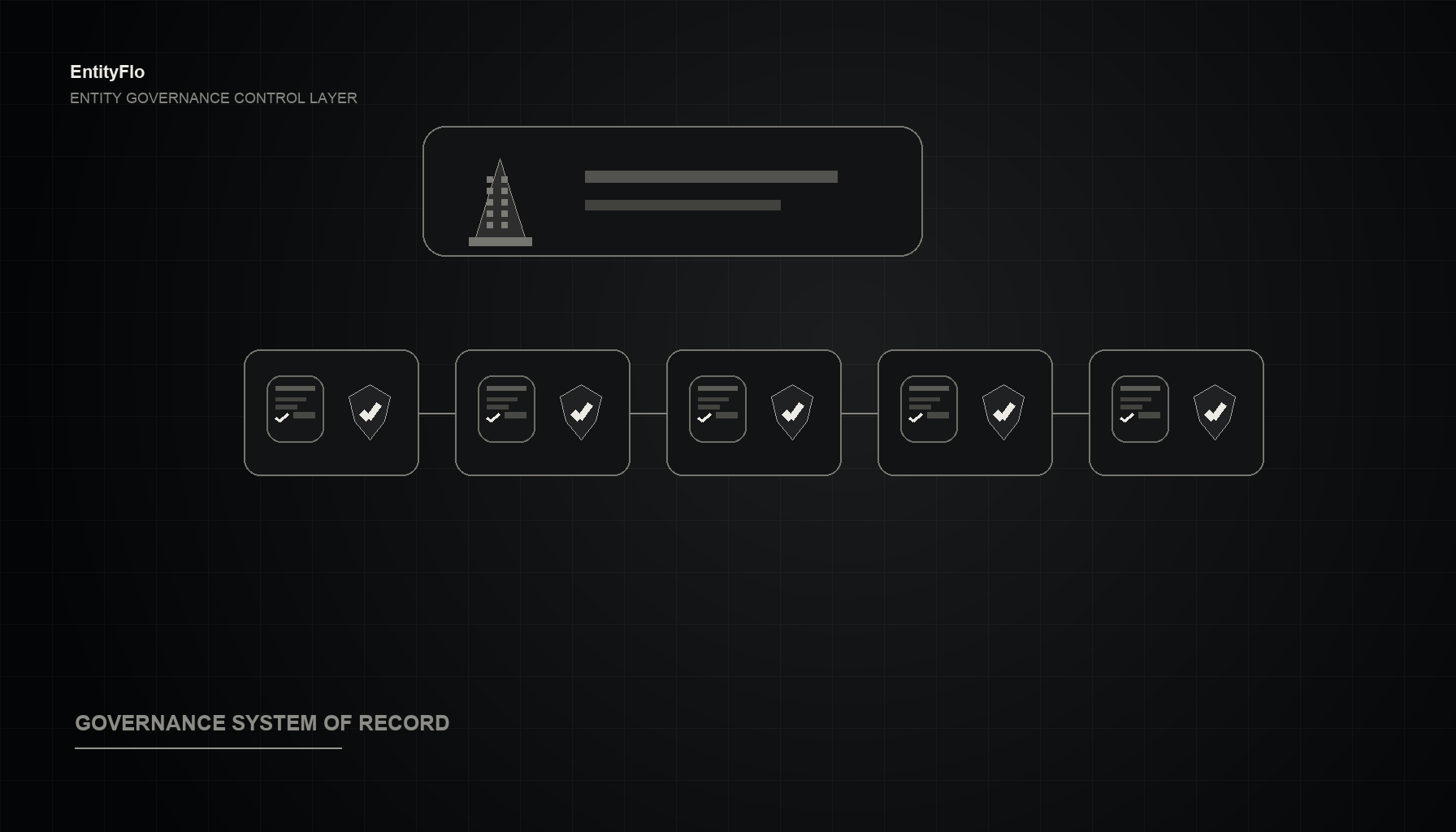
Subsidiary governance is the system a corporate group uses to keep every controlled entity accurate, compliant, visible and decision-ready. For CFOs, General Counsel and internal Company Secretaries, it means knowing which entities exist, who owns them, who controls them, what obligations apply, what decisions have been approved and where the evidence sits.
In a small group, subsidiary governance can feel like administration. In a larger group with operating companies, holding companies, trustee companies, SPVs, dormant entities and adviser-held records, it becomes a core control environment. The question is whether the group can prove the current state of every entity quickly and consistently.
This article is general information only, not legal advice.
What Is Subsidiary Governance?
Subsidiary governance is the operating framework for managing the legal entities inside a corporate group. It covers company records, directors and secretaries, members or shareholders, ownership, delegated authorities, board and member approvals, regulatory filings, annual reviews, documents, registers and evidence.
For Australian groups, subsidiary governance often includes ASIC company details, annual review workflows, solvency resolutions, Form 484 change events, director and secretary records, member registers, share structures and lodgement evidence. Listed, regulated and cross-border groups may also need to coordinate other jurisdictional requirements depending on the structure.
ASIC's guidance for Australian companies is a useful baseline: companies need to keep company records, keep company details up to date, notify ASIC of many changes within required timeframes and retain financial records. ASIC also says company records may be kept electronically, provided they can be produced in hard copy within a reasonable timeframe.
Sources: ASIC company record keeping, ASIC company officeholders, ASIC annual review and ASIC Form 484.
Why Subsidiary Governance Becomes a CFO Problem
Subsidiary governance often starts with legal or company secretarial teams, but the consequences of weak subsidiary control usually land with the CFO.
Finance teams rely on accurate entity records for audit, tax, banking, reporting, debt facilities, insurance, acquisitions, divestments, restructures and board packs. If the group cannot confirm the right entity owner, officeholders, shareholding, status, obligations and approval trail, finance has to reconstruct the truth from emails, spreadsheets, adviser portals, document folders and ASIC extracts.
That creates avoidable friction in moments that already carry pressure:
- year-end audit requests
- refinancing or lender due diligence
- acquisition or sale preparation
- group restructure planning
- director or secretary changes
- annual review season
- board reporting
- regulator queries
- handover between CFOs, GCs, Company Secretaries or advisers
The risk is not always a missed filing. Sometimes the larger problem is operational uncertainty. A company can be compliant in one narrow sense and still be difficult to govern because the records are fragmented.
The Common Failure Pattern: Entity Sprawl Without a Control Layer
Most subsidiary governance issues come from the same pattern: the group keeps creating or acquiring entities, but the control layer does not mature at the same speed. Each event is manageable in isolation, but over time the group accumulates records in different systems and with different owners.
Common symptoms include:
- no single agreed entity list
- ASIC records that do not match internal registers
- director, secretary or signatory records that have drifted
- annual review evidence stored outside the entity file
- share transfers or issues recorded in one place but not another
- board approvals detached from the resulting register or filing change
- adviser-owned files that internal teams cannot access quickly
- key-person dependency on the one person who "just knows"
This is why subsidiary governance should be treated as a repeatable operating system, not a periodic cleanup project.
A Practical Subsidiary Governance Framework
A workable subsidiary governance framework does not need to be complicated. It needs to answer five questions for every entity in the group:
- What is the entity?
- Who owns and controls it?
- What obligations apply?
- What changed, and who approved it?
- Where is the evidence?
The framework below gives CFOs, GCs and governance teams a practical way to assess the current state.
1. Build a Complete Entity Master List
Start with the entity universe. If the master list is incomplete, every downstream governance process becomes unreliable.
For each entity, capture:
- legal name
- ACN, ABN or equivalent identifier
- entity type
- jurisdiction
- registration date
- annual review date or local equivalent
- registered office
- principal place of business
- status: active, dormant, trustee, SPV, holding company, operating company, divestment candidate or deregistration candidate
- internal owner
- external adviser or registered agent
- purpose of the entity within the group
The "purpose" field matters. It helps teams distinguish active operating entities from historical, dormant or single-purpose entities. It also reduces confusion during audit, reporting, insurance and restructure work.
2. Reconcile Public Registry Data Against Internal Records
For Australian companies, ASIC records should be reconciled against internal records for officeholders, registered office, principal place of business, member details for proprietary companies, share structure, ultimate holding company and registered agent details where relevant.
ASIC's Form 484 guidance covers changes to company details, including addresses, officeholders, shares and member details. ASIC also notes that many company detail changes need to be notified within required timeframes, commonly within 28 days.
For each subsidiary, check:
- Does the ASIC record match the internal register?
- If not, which record is correct?
- Is there evidence supporting the correct position?
- Was a required lodgement made?
- Is the lodgement receipt saved against the relevant entity and event?
- Does the structure chart reflect the same position?
This review should produce exceptions, not vague confidence. A useful output is a group-level exception report showing entity, issue, evidence gap, owner and next action.
3. Connect Ownership, Control and Beneficial Ownership Indicators
Subsidiary governance is weaker when ownership records sit in one place and control records sit somewhere else.
At minimum, governance teams should be able to see:
- immediate shareholder or member
- ultimate holding company, if applicable
- share classes and holdings
- beneficial ownership indicators where recorded
- trustee relationships
- nominee or bare trust arrangements where relevant
- director and secretary appointments
- delegated authorities
- bank signatories and execution authorities where relevant
- group structure chart or ownership map
Ownership records are not just corporate housekeeping. They affect tax, reporting, due diligence, banking, risk, conflicts and board decision-making. When ownership data is stale, the group may struggle to explain who controls what, which entities are connected and which approvals are needed.
4. Calendar Obligations by Entity, Not by Inbox
Subsidiary obligations should be visible at the entity level and at the group level. A reminder in one person's calendar is not a control framework.
For Australian companies, recurring obligations may include annual reviews, fee payment, solvency resolutions, financial reporting obligations for companies that must prepare or lodge reports, officeholder updates, member or share changes, registered office changes and other event-based filings. Other obligations may come from financing documents, licences, insurance, leases, trust deeds, shareholder agreements or industry-specific regulation.
For each obligation, record:
- entity
- obligation type
- source of obligation
- owner
- due date or trigger
- status
- approval required
- evidence required
- completion date
The CFO-level view should show exceptions across the group: overdue items, upcoming deadlines, missing evidence, entities without owners and obligations blocked by missing approvals.
5. Link Decisions to Filings, Registers and Evidence
Good subsidiary governance creates a chain from decision to outcome.
For example, a director appointment should connect:
- consent to act
- approval or resolution
- effective date
- ASIC update, if required
- updated director register
- updated signing authority or delegation record, if relevant
- lodgement receipt or confirmation
- documents stored against the right entity
The same principle applies to share issues, share transfers, address changes, secretary changes, annual reviews, solvency resolutions, restructures and deregistration decisions.
Without this chain, teams can end up with isolated facts but no defensible record. The approval is in board papers, the lodgement is in an adviser portal, the updated register is in a spreadsheet and the receipt is in someone's inbox. That may work until audit, due diligence or handover asks the team to prove the story.
6. Define Clear Ownership Between Finance, Legal, CoSec and Advisers
Subsidiary governance fails when everyone assumes someone else owns the record.
A clear operating model should define:
- who owns the entity master list
- who owns ASIC updates and annual reviews
- who owns board and member approvals
- who owns registers and structure charts
- who owns document retention
- who approves changes before lodgement
- who reports exceptions to the CFO, GC or board
External advisers can be valuable, especially for technical lodgements and specialist advice. But internal leaders still need visibility. Outsourcing the task should not mean outsourcing the group's memory.
Subsidiary Governance Checklist for CFOs and Governance Teams
Use this checklist as a practical diagnostic across the group.
Entity Control
- Is there one current list of every subsidiary, SPV, trustee company and dormant entity?
- Does each entity have a clear purpose, owner and status?
- Are entity records accessible to the people who need them?
- Can the group distinguish active, dormant, trustee, holding and operating entities?
Registry and Register Accuracy
- Do ASIC records match internal registers?
- Are registered office and principal place of business details current?
- Are directors and secretaries current?
- Are member, shareholder and share structure records current?
- Are ultimate holding company records current where applicable?
- Are discrepancies tracked to resolution?
Obligation Management
- Does every entity have a visible obligation calendar?
- Are annual reviews, fees and solvency resolutions tracked?
- Are event-based filing triggers captured?
- Does each obligation have an owner, due date, status and evidence requirement?
- Can the CFO see overdue or upcoming exceptions across the group?
Evidence Trail
- Are approvals linked to the filings, register updates and documents they support?
- Are ASIC receipts and confirmations saved against the relevant event?
- Are minutes, resolutions, consents and lodgement evidence easy to produce?
- Are document versions controlled?
- Could a new CFO, GC or Company Secretary reconstruct the group position quickly?
Reporting and Handover
- Can the team produce a board-ready entity report?
- Can the group explain ownership and control without relying on one person's memory?
- Are adviser-held records mirrored or accessible internally?
- Are open issues visible in a group-level exception report?
- Is the governance record ready for audit, due diligence or restructure?
What Good Looks Like
In a mature subsidiary governance environment, the CFO does not need to ask five people for the latest entity truth.
The group can see every entity, owner, officeholder, register, obligation, approval, filing, document and evidence trail from one trusted record. Finance can prepare for audit without record chasing. Legal can verify approvals and authority. Company Secretaries can manage annual reviews, lodgements and registers without rebuilding spreadsheets. The board can rely on reports that connect back to current records.
That does not remove the need for judgement, advice or review. It gives the people making those judgements a stronger factual base.
Where Entity Management Software Fits
Subsidiary governance can be managed in spreadsheets for a while. The problem is that spreadsheets do not naturally enforce evidence trails, ownership, register history, approval workflows, document versioning or group-wide exception reporting.
Entity management software becomes useful when the group needs one structured place to manage entities, people, roles, ownership, obligations, registers, resolutions, documents and evidence. For Australian groups, the strongest use case is not just filing forms. It is creating a governance system of record underneath ASIC compliance, board reporting, audit readiness and handover.
EntityFlo is built for Australian corporate groups, CFOs, General Counsel, Company Secretaries and CoSec providers who need total governance control without spreadsheet chaos.
Related EntityFlo Resources
- Governance system of record
- Entity management software Australia
- ASIC compliance software
- ASIC annual review checklist
- Corporate register cleanup checklist
FAQ
What is subsidiary governance?
Subsidiary governance is the framework a corporate group uses to manage the records, obligations, approvals, registers, ownership, directors, documents and evidence trails for its subsidiaries and controlled entities.
Who owns subsidiary governance in a corporate group?
Ownership varies by organisation. In many groups, responsibility is shared between the CFO, General Counsel, Company Secretary, finance team, legal team and external advisers. The important control point is that ownership is explicit for each record, obligation, filing and approval process.
Why does subsidiary governance matter to CFOs?
CFOs rely on accurate subsidiary records for audit, reporting, banking, tax, insurance, restructures, acquisitions, divestments and board reporting. Weak subsidiary governance creates record-chasing, uncertainty and avoidable risk when the group needs reliable evidence quickly.
What should a subsidiary governance framework include?
A practical framework should include an entity master list, registry reconciliation, ownership and control records, obligation calendars, approval workflows, document retention, evidence trails, exception reporting and clear ownership between finance, legal, CoSec and advisers.
How often should subsidiary records be reviewed?
Subsidiary records should be reviewed at regular control points such as annual reviews, audit preparation, board reporting cycles, restructures, director changes, share changes, acquisitions and handovers. Event-based changes should be updated when they occur, not left for an annual cleanup.
Can subsidiary governance be managed in spreadsheets?
Spreadsheets can work for small or simple groups, but they become fragile as entity count, obligations, approvals and adviser involvement grow. They are especially weak for evidence trails, version control, register history, permissions, workflow status and group-wide exception reporting.
Demo CTA
If your subsidiary records live across spreadsheets, shared drives, ASIC extracts, adviser portals and inboxes, EntityFlo can help you bring the group record into one governance system of record.
Book a demo to see how EntityFlo helps CFOs, GCs and Company Secretaries manage subsidiary governance, ASIC workflows, ownership records, approvals and evidence trails across multi-entity groups.