What Is a Governance System of Record?
A governance system of record connects entity facts, obligations, decisions, approvals, filings and evidence in one authoritative source.
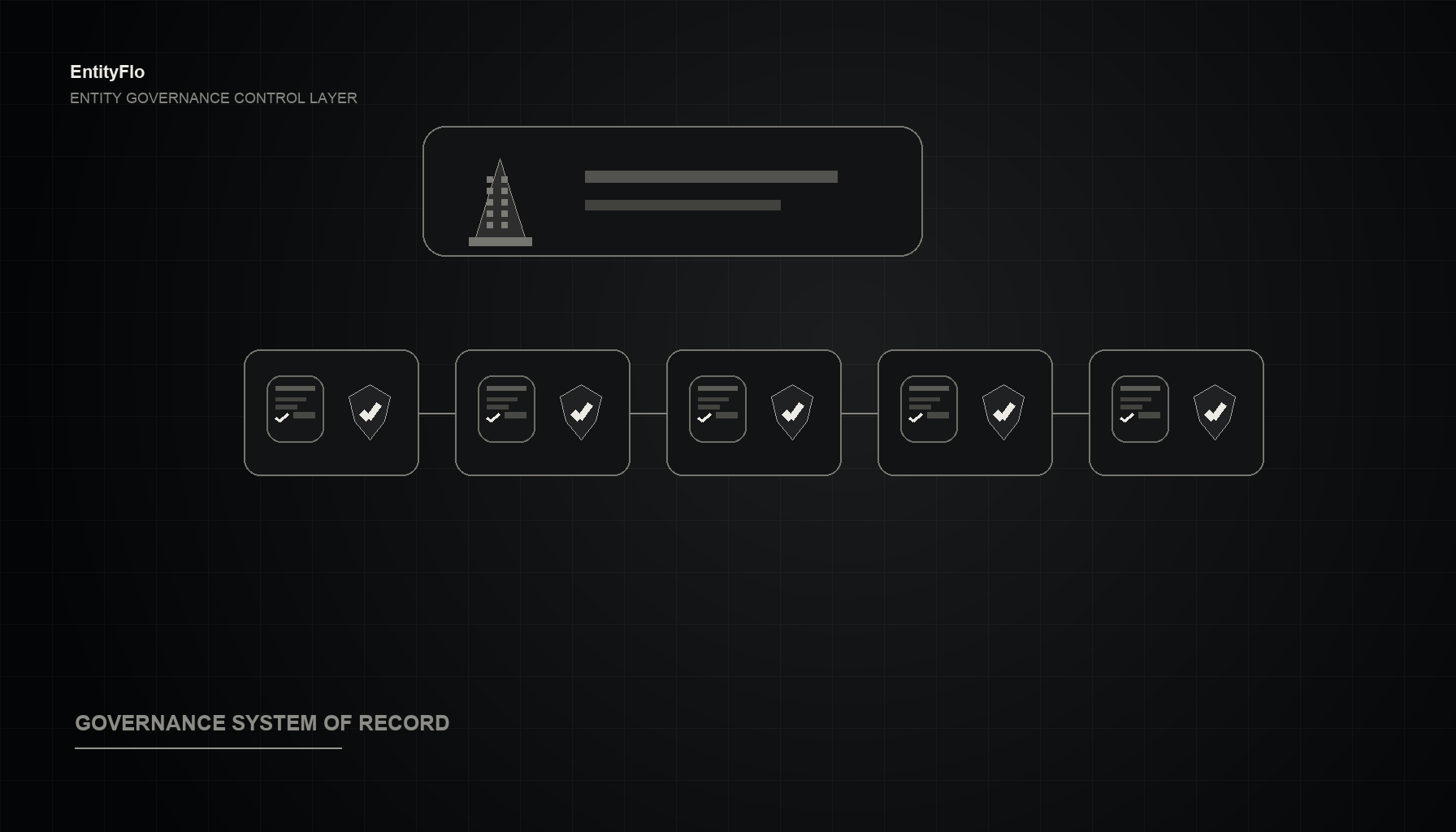
A governance system of record is the trusted place where an organisation maintains the current facts, decisions, obligations, approvals, and evidence connected to its legal entities.
It does more than store documents. It connects what happened, who approved it, what changed, what was filed, and where the supporting evidence lives.
For a corporate group managing multiple entities, this distinction matters. A spreadsheet may list directors. A shared drive may contain resolutions. An adviser may hold ASIC records. But unless those records are connected and current, the organisation still lacks a reliable view of its governance position.
What Does "System of Record" Mean?
A system of record is the authoritative source for a particular type of business information.
Finance teams use accounting platforms as the system of record for financial transactions. Sales teams use a CRM as the system of record for customer relationships. People teams use an HR platform as the system of record for employee data.
Governance information deserves the same treatment.
A governance system of record gives the organisation one controlled source for the information needed to understand and operate its entities, including:
- Legal entity details
- Directors, officers, and authorised signatories
- Shareholders, members, and ownership relationships
- Statutory and internal registers
- Compliance obligations and deadlines
- Board and shareholder decisions
- Resolutions, minutes, and approvals
- Registry filings and confirmations
- Constitutions, trust deeds, and other core documents
- A history of changes and supporting evidence
The goal is not simply to centralise files. It is to preserve the relationship between every governance action and the records that prove it occurred.
Why Shared Drives and Spreadsheets Are Not Enough
Spreadsheets and shared drives are useful tools. Most growing groups rely on them because they are flexible, familiar, and quick to set up.
The problem appears as the group becomes more complex.
A spreadsheet can show that a director was appointed, but it may not show:
- Who approved the appointment
- Whether the resolution was executed
- Whether the relevant registry filing was completed
- Whether the internal register was updated
- Whether bank mandates and signing authorities were reviewed
- Which version of each document is current
A shared drive can store the supporting documents, but it usually cannot confirm that every required step was completed or identify discrepancies across the group.
This creates a fragmented governance environment. The facts may exist, but reconstructing the full story requires searching across folders, inboxes, spreadsheets, and external advisers.
The Difference Between Storage and Governance Control
Document storage answers:
Where is the file?
A governance system of record answers:
What happened, who approved it, what changed, what remains outstanding, and what evidence supports the record?
That difference becomes important during:
- Audits
- Due diligence
- Financing and refinancing
- Acquisitions and restructures
- Board reporting
- Executive or Company Secretary handovers
- Regulatory reviews
When records are connected, teams can answer questions from the board, auditors, lenders, investors, and advisers without rebuilding the history from scratch.
What Should a Governance System of Record Contain?
1. A Complete Entity Register
The foundation is a current register of every company, trust, partnership, joint venture, and special purpose vehicle in the group.
Each entity record should include its key details, status, officers, ownership, documents, obligations, and recent governance activity.
2. Ownership and Control Relationships
Legal ownership is rarely captured adequately in a flat spreadsheet. A governance system of record should show how entities and individuals are connected, including direct and indirect holdings where relevant.
This makes it easier to understand group structure, prepare for due diligence, and identify records requiring review when ownership changes.
3. Obligations and Accountability
A compliance calendar alone lists dates. A stronger system connects each obligation to:
- The responsible person
- The relevant entity
- Required approvals
- Supporting documents
- Completion evidence
- Escalation if the task remains outstanding
This turns a deadline into a controlled workflow.
4. Decisions, Approvals, and Resolutions
Governance depends on evidence that decisions were properly made and recorded.
A governance system of record should connect each material action to the relevant approval, resolution, minute, signature, and resulting change. This provides a traceable path from decision to execution.
5. Registry and Internal Records
External registry information and internal company records can diverge. A reliable governance process should make discrepancies visible and provide a controlled way to investigate and resolve them.
The objective is not to assume one source is always correct. It is to know when records differ and document how the difference was addressed.
6. An Audit Trail
The organisation should be able to see who changed a record, when it changed, and why.
That history supports accountability and preserves corporate memory when employees, advisers, or directors change.
Who Needs a Governance System of Record?
The need usually becomes clear when governance work is spread across multiple people and systems.
Common signs include:
- The group manages numerous entities or SPVs.
- Entity information is maintained in several spreadsheets.
- Governance records sit across email, shared drives, and adviser portals.
- One employee or external adviser holds most of the corporate knowledge.
- Teams regularly reconcile internal information against registry records.
- Preparing for audit or due diligence requires a manual document hunt.
- Board reporting depends on asking several people for updates.
Corporate groups, property developers, family offices, private investment groups, and other organisations with complex structures are particularly exposed to these problems.
Governance System of Record vs Other Tools
Governance System of Record vs Document Management System
A document management system organises and controls files. It may provide search, permissions, and version history.
A governance system of record connects those files to entities, obligations, decisions, approvals, filings, ownership changes, and structured records.
Governance System of Record vs Board Portal
A board portal helps distribute board packs, manage meetings, and support director collaboration.
A governance system of record covers the broader operating history of the group's legal entities, including registers, filings, ownership, obligations, and evidence outside the board meeting cycle.
Governance System of Record vs Compliance Calendar
A compliance calendar tracks deadlines and reminders.
A governance system of record connects the deadline to responsibility, workflow, completion, resulting record changes, and evidence.
Governance System of Record vs an External Adviser
External advisers provide valuable expertise and execution support. However, the organisation still needs internal visibility over what was approved, filed, changed, and retained.
A governance system of record can improve collaboration with advisers by giving both parties access to current, structured information.
The Governance Handover Test
A practical way to assess your current system is to ask:
If the person who knows the most about our entities left tomorrow, could a new CFO, General Counsel, or Company Secretary reconstruct the group's governance position in one day?
Could they identify:
- Every active entity and its purpose?
- Current directors, officers, shareholders, and signatories?
- Upcoming obligations and overdue actions?
- The latest approved registers?
- The evidence supporting recent changes?
- Differences between internal and external records?
- Outstanding approvals or filings?
If the answer depends on a particular person's memory, the organisation does not yet have a reliable governance system of record.
How to Build One
Start with the information required to answer real governance questions, not with a plan to migrate every historical file.
- Create a complete inventory of entities and responsible owners.
- Identify the authoritative source for each key data type.
- Reconcile current officers, ownership, addresses, and registers.
- Connect active obligations to owners, workflows, and evidence.
- Link recent material decisions to approvals, resolutions, filings, and resulting changes.
- Define access controls and change-management rules.
- Establish a regular process for reviewing discrepancies and stale records.
The system becomes valuable when teams use it as part of daily governance work, rather than treating it as a static repository updated before an audit.
How EntityFlo Supports Governance Operations
EntityFlo is designed for internal finance, legal, governance, and Company Secretarial teams managing multi-entity groups.
It brings entity records, obligations, registers, ownership relationships, approvals, resolutions, documents, and evidence trails into one operating environment. The aim is to give the organisation a current view of its governance position while supporting controlled collaboration with directors and external advisers.
Instead of asking where the latest spreadsheet or resolution sits, teams can work from a connected governance record built around each entity.
Frequently Asked Questions
What is a governance system of record?
A governance system of record is the authoritative source for an organisation's entity information, obligations, decisions, approvals, filings, registers, documents, and supporting evidence. It connects governance activity to the records that prove what occurred.
Is a shared drive a governance system of record?
Usually not. A shared drive can store governance documents, but it generally does not connect those documents to structured entity records, obligations, approvals, filings, and resulting changes.
Is entity management software a governance system of record?
Entity management software can serve as a governance system of record when it maintains structured entity data and connects it to obligations, ownership, decisions, documents, filings, and evidence trails.
Does a governance system of record replace external advisers?
No. It gives the organisation a controlled internal record and can make collaboration with accountants, lawyers, and Company Secretarial advisers more efficient.
What is the main benefit of a governance system of record?
The main benefit is reliable governance visibility. Teams can understand the current position of each entity and retrieve the evidence behind changes without reconstructing the history across spreadsheets, inboxes, folders, and adviser systems.