How to Build an Audit-Ready Governance Evidence Trail
A governance audit trail is the connected record that proves what changed, who approved it, what source information was used, what was lodged or updated, and where the evidence lives. For Australian groups, it should connect board decisions, ASIC records, registers, reporting inputs, minutes, res...
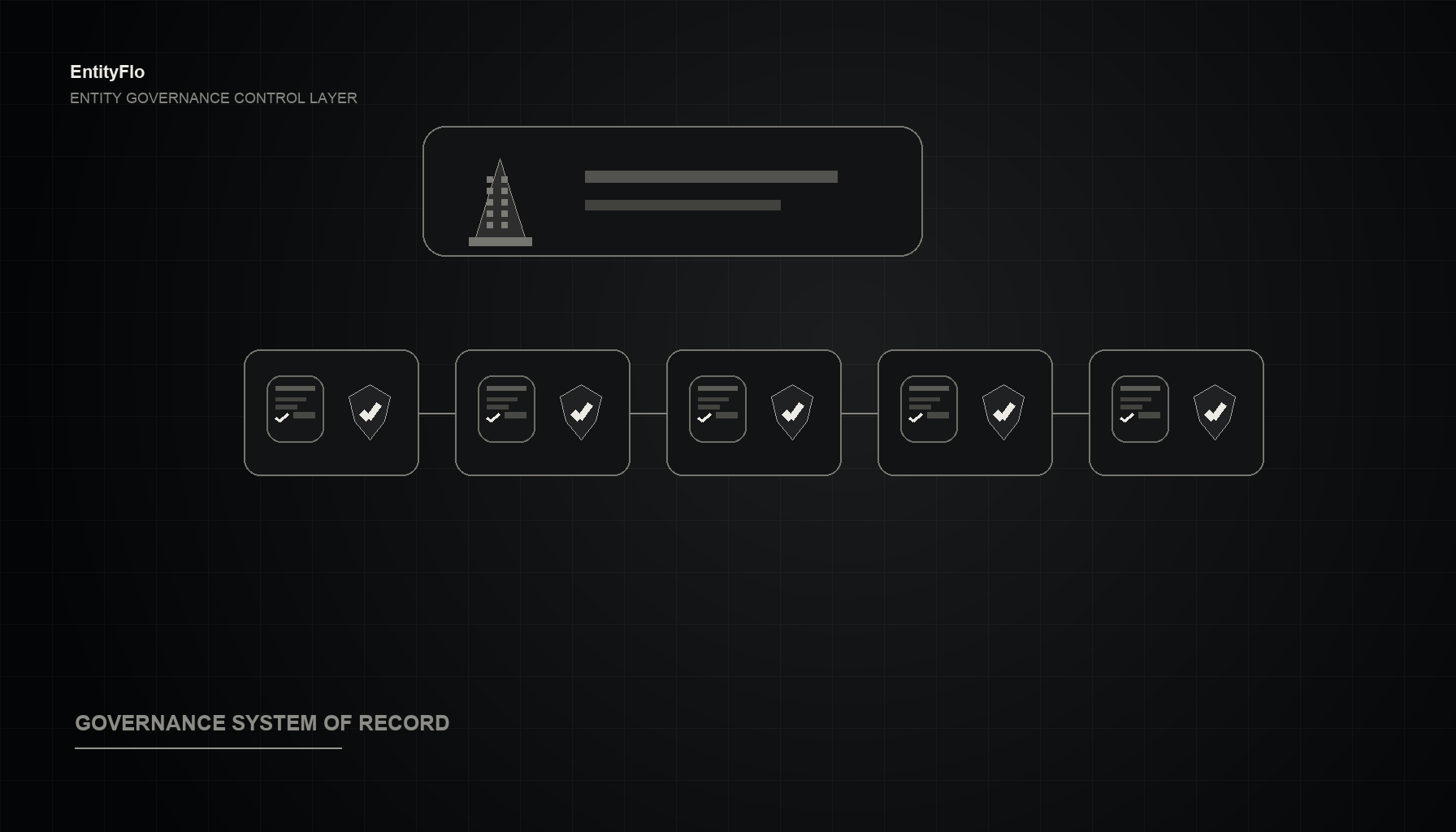
A governance audit trail is the connected record that proves what changed, who approved it, what source information was used, what was lodged or updated, and where the evidence lives. For Australian groups, it should connect board decisions, ASIC records, registers, reporting inputs, minutes, resolutions, approvals and owner sign-off in one traceable workflow.
ASIC's 2026-27 focus areas make this timely. The regulator has said directors are primarily responsible for financial report quality, that significant judgements should be documented at the time, and that companies need processes and records to support information in financial reports.
Why Governance Audit Trails Matter Now
Audit-ready governance is not only an audit-team problem. It is a board, CFO, General Counsel and Company Secretary problem because important company decisions often sit across several systems.
A board may approve a restructure. Finance may adjust the reporting pack. Legal may update an entity register. A company secretary may lodge an ASIC change. An external adviser may hold the signed document. If those records are scattered, the group has to reconstruct the truth under pressure.
That pressure is increasing. ASIC's 2026-27 reporting, audit and sustainability focus areas refer to financial reports of listed and unlisted companies, significant judgement areas, audit file reviews, non-lodgement of financial reports by large proprietary companies, sustainability reports and auditor oversight. ASIC's directors and financial reporting guidance also says directors must take reasonable steps to comply with, or secure compliance with, financial reporting and audit requirements, including proper books and records.
An audit-ready governance evidence trail should answer seven questions without relying on one person's memory.
The Seven-Layer Governance Audit Trail Framework
Use this framework for decisions or records that may later matter to directors, auditors, ASIC, investors, lenders, buyers or internal assurance teams.
1. The Decision Record
Start with the decision itself.
For each material governance event, record:
- what decision was made
- which entity or entities it affected
- whether the decision was made by directors, members, a committee, management or an authorised delegate
- the date of approval
- the version of the paper, resolution or written consent that was approved
- any conditions, follow-up actions or effective dates
- who owns completion after approval
Many evidence failures begin after a valid decision is made. The board approved the change, but no one can later prove which version was approved, whether conditions were met, whether the register was updated, or whether the lodgement happened.
ASIC's company meetings and resolutions guidance notes that certain company decisions must be made by resolution, and that resolutions should be put into company records within one month of the vote and minutes signed by the relevant chair. Treat that as the minimum starting point, not the full evidence trail.
2. The Source Information
Next, record the information relied on when the decision was made.
Examples include:
- board papers
- management accounts
- cash flow forecasts
- valuation papers
- impairment assessments
- revenue recognition analysis
- risk reports
- sustainability reporting assumptions
- adviser memos
- external expert reports
ASIC's financial reporting focus areas call out areas involving judgement, including asset impairment, revenue recognition, financial instruments, provisions, subsequent events, presentation and disclosure. It also says the basis and circumstances related to management's judgements on accounting estimates and forward-looking information should be documented at the time and disclosed in the financial report.
That phrase, "documented at the time", is a useful standard. Evidence created months later is weaker than a clear record created when the decision was made.
3. The Approval Path
A decision is easier to defend when the approval path is clear.
For each event, capture:
- who prepared the paper or recommendation
- who reviewed it before approval
- who approved it
- whether any director abstained or declared an interest
- whether any external advice was obtained
- whether the decision needed member approval, lender consent, trustee approval, board committee approval or ASIC notification
The approval path should also show timing. A governance record that only says "approved" is often not enough. A better record says what was approved, by whom, through what authority, on what date, and against which source documents.
This is especially important where one commercial decision creates several legal or governance actions.
4. The Register and Registry Update
The next layer is the gap between "approved" and "updated". For each governance event, confirm whether it required:
- an internal register update
- an ASIC lodgement or other registry update
- a share register update
- an officer or director register update
- a beneficial ownership or ownership map update
- an obligation, deadline or board action update
ASIC's company record keeping guidance says companies must keep certain records, that financial records should correctly track and explain transactions and financial position, and that digital records must be producible in hard copy within a reasonable timeframe if requested.
The internal record and external register should not drift apart. If a director change is approved, the evidence trail should show the approval, consent, effective date, ASIC lodgement status, internal register update, evidence location and next check.
5. The Evidence Location
Every important record needs a location that another person can find. Common evidence includes:
- signed resolutions
- signed minutes
- signed consent to act or resignation letters
- ASIC annual statements and invoices
- ASIC lodgement confirmations and receipts
- board packs and appendices
- executed deeds and agreements
- registers and register change logs
- auditor request responses
- sustainability reporting working papers
- financial reporting position papers
The issue is not whether the evidence exists somewhere. The issue is whether the right person can find the right version quickly.
A practical standard: for any material governance action, a new CFO, GC or Company Secretary should be able to find the full evidence pack in under 15 minutes without asking the person who originally handled it.
6. The Owner and Status
Audit trails fail when ownership is vague.
Every action should have:
- responsible owner
- approver
- current status
- due date
- completed date
- exception reason, if incomplete
- next review date
This matters because governance work often moves between functions. Finance may own management accounts. Legal may own contracts. CoSec may own minutes and lodgements. External advisers may hold ASIC portal access. Directors may own final judgement. Without an owner and status, the evidence trail becomes a reconstruction exercise.
The owner/status layer also helps management answer board or auditor questions quickly:
- Which entities still have unresolved annual review exceptions?
- Which director changes were approved but not lodged?
- Which register updates have no source document attached?
- Which subsidiaries have outstanding audit evidence requests?
Those are governance control questions.
7. The Review and Exception Log
The final layer is review.
An audit-ready governance trail should show:
- when the record was last reviewed
- who reviewed it
- what exceptions were found
- what was corrected
- what could not be corrected immediately
- what risk or dependency remains
- when the next review is due
This is where governance becomes more than storage. A folder can hold records. A control process shows whether records are current, complete and reliable. For a multi-entity group, an exception log might include:
- missing signed minutes
- ASIC data that does not match internal registers
- stale officer or address records
- old share register entries with no supporting transfer documents
- annual review evidence stored outside the company record
- reporting judgement papers not linked to board approval
The exception log gives CFOs, GCs and Company Secretaries a working control view. It also helps avoid the false comfort of "we have the documents somewhere."
A 30-Minute Governance Evidence Diagnostic
Use this diagnostic this week. Pick one entity, one board decision and one reporting judgement from the last 12 months.
For each item, ask:
- Can we identify the exact decision or judgement?
- Can we find the source paper or analysis that supported it?
- Can we see who reviewed and approved it?
- Can we confirm whether any register or ASIC update was required?
- Can we prove the update was completed, or explain why it was not?
- Can we find the signed document, minutes, lodgement receipt or register entry?
- Can we identify the current owner and status?
- Can someone outside the original process reconstruct the record quickly?
If the answer is no to two or more questions, the problem is not one missing document. The governance evidence trail is not controlled.
What Good Looks Like
An audit-ready governance evidence trail does not need to be complicated. It does need to be consistent.
For each entity, the team should be able to see:
- current directors, secretaries, members and registered details
- current register position and last verified date
- annual review date and evidence
- open obligations and owners
- recent board and member decisions
- source documents attached to each material event
- unresolved exceptions
For each decision, the team should be able to trace:
- decision made
- source information relied on
- approval path
- record update required
- lodgement or filing status
- signed evidence
- owner, completion date and next review point
That is the difference between a document archive and a governance control layer.
Where EntityFlo Fits
EntityFlo is designed for governance and entity management teams that need one trusted place for entity records, obligations, registers, approvals, documents and evidence trails.
Instead of leaving the audit trail scattered across spreadsheets, inboxes, shared drives, adviser portals and board packs, EntityFlo helps teams connect the entity record to the work around it: officeholders, ownership, annual reviews, resolutions, filings, documents, status and history.
The goal is not to remove human judgement. Directors, CFOs, General Counsel and Company Secretaries still need to review, question and approve the important decisions. The goal is to make the record underneath those decisions current, traceable and easier to verify.
For teams managing multiple entities, that system-of-record layer turns governance evidence from a search exercise into an operating control.
Sources
- ASIC, "26-098MR ASIC sets financial reporting, audit and sustainability focus areas for FY 2026-27": https://www.asic.gov.au/about-asic/news-centre/find-a-media-release/2026-releases/26-098mr-asic-sets-financial-reporting-audit-and-sustainability-focus-areas-for-fy-2026-27/
- ASIC, "Financial reporting and audit focus areas": https://www.asic.gov.au/regulatory-resources/financial-reporting-and-audit/financial-reporting-and-audit-focus-areas/
- ASIC, "Directors and financial reporting": https://www.asic.gov.au/regulatory-resources/financial-reporting-and-audit/directors-and-financial-reporting/
- ASIC, "26-164MR ASIC reminds Registered Company Auditors of their obligations and outlines stronger oversight": https://www.asic.gov.au/about-asic/news-centre/find-a-media-release/2026-releases/26-164mr-asic-reminds-registered-company-auditors-of-their-obligations-and-outlines-stronger-oversight/
- ASIC, "Company record keeping": https://www.asic.gov.au/for-business-and-companies/companies/company-building-blocks/company-record-keeping/
- ASIC, "Company meetings and resolutions": https://www.asic.gov.au/for-business-and-companies/companies/company-building-blocks/company-meetings-and-resolutions/
FAQ
What is a governance audit trail?
A governance audit trail is the connected record of a governance decision or event. It shows what happened, who approved it, what information was relied on, what changed, where the evidence is stored and who owns the current status.
Why does a governance audit trail matter?
It matters because directors, auditors, advisers, regulators, lenders and buyers may later need to understand how a decision was made and whether the supporting records were complete. A strong audit trail reduces reliance on memory, inboxes and manual reconstruction.
What should be included in a governance evidence trail?
At minimum, include the decision record, source documents, approval path, register or registry updates, signed evidence, owner, status, completion date, exceptions and next review date.
Is a document folder enough for audit-ready governance?
Usually not. A folder may store documents, but it does not necessarily show which decision they support, whether the right version was approved, whether a register or ASIC update was completed, or who owns unresolved exceptions.
How often should governance evidence be reviewed?
Governance evidence should be reviewed after material changes and as part of recurring controls such as annual review, reporting preparation, audit readiness, due diligence preparation and board action follow-up. Multi-entity groups should also run periodic exception reports.
Who should own governance audit trails?
Ownership depends on the organisation, but CFOs, General Counsel, Company Secretaries and governance teams usually share responsibility. The key is to assign a named owner for each entity, obligation, decision and exception rather than leaving ownership implied.
How does software help with governance audit trails?
Software helps when it connects entity records, registers, obligations, approvals, lodgements, documents and status in one place. The value is not just storage. The value is traceability: being able to move from a decision to the source evidence and current record quickly.
Book a Demo
If your governance evidence still lives across spreadsheets, shared drives, board packs, ASIC portals and adviser inboxes, book an EntityFlo demo. We will show you how a governance system of record can help your team make entity records, obligations, approvals and evidence trails easier to control across the group.
We use cookies to improve your experience. Essential cookies are always active.