Governance Workflows.
Where the work gets done.
Every corporate event — appoint a director, issue shares, change a registered office, close an entity — runs as a single Action with the right steps, documents, consents, filings and registers updated automatically. One wizard, one workflow, one record.
Your first entity is free. No credit card required.
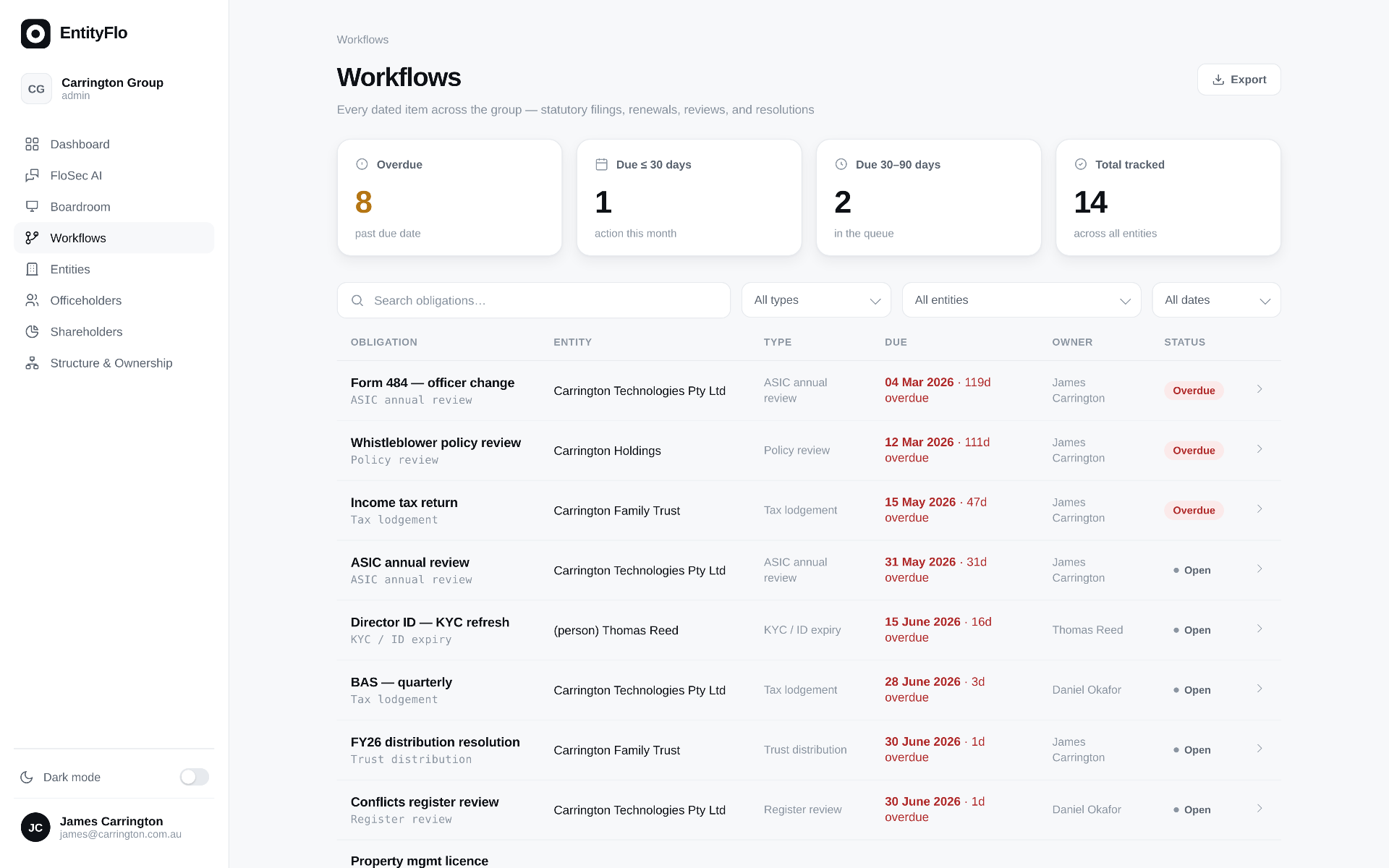
Corporate events run on tribal knowledge.
Every change — a new director, a share issue, a registered office update — needs a different combination of resolutions, consents, filings and register updates. The steps live in someone's head. Things get missed. Filings are late. Registers fall out of sync.
Steps reinvented every time
A Form 484 needs a resolution, a director consent, a register update and an ASIC lodgement. Each one is run separately, often by different people, often out of order.
Documents drafted from scratch
Resolutions, consents, notices and minutes get rewritten for every event — when the same template, with the right entity data, would do the job in seconds.
Registers drift from reality
The change happens. The register update doesn't. Months later, the register, ASIC and the bank all show different versions of the truth.
No single record of what was done
The resolution sits in one folder, the consent in another, the lodgement receipt in email. Reassembling what happened takes hours per event.
One Action. Every step. Every record.
EntityFlo ships 25 pre-built action types across five categories. Each one knows the steps, drafts the documents, captures the consents, lodges the filing and updates the register — in one workflow.
Join Beta25 action types, ready to run
Entity formation and closure, officer appointments and resignations, share issues and transfers, governance decisions, custom workflows — every corporate event is a first-class Action.
Documents drafted automatically
FloSec AI generates the resolution, the consent, the notice and the minutes from your templates and live entity data — citing the relevant constitutional clause.
Filings prepared and lodged
File and lodge every form directly with ASIC (AU), the Companies Office / NZBN (NZ), Companies House (UK) and equivalents abroad. Form 484, Form 410, annual reviews, NZ Form 1, CS01 and equivalents are pre-filled from the Action data, validated against regulator rules, and lodged through the ASIC integration — either under your own ASIC agent number or with EntityFlo as your appointed agent.
Registers update themselves
When an Action completes, the relevant registers — directors, members, options, charges, beneficial owners — update automatically. No double entry. No drift.
One immutable record per event
Every Action carries its own evidence pack: who initiated, who approved, what documents were generated, when the filing was lodged. Audit-ready by default.
Inside Governance Workflows.
The five capabilities that make governance workflows work.
The rest of the platform.
Governance Workflows connects to every other pillar — decisions flow, records sync, nothing lives alone.
Take control of your
entity portfolio.
Your first entity is free. No credit card, no lock-in. Set up in under 15 minutes.
Entity Register
Every entity, officer and shareholder in one live register.
ExploreGovernance Workflows
From board decision to registered outcome. Every step tracked.
ExploreCompliance Engine
Continuous compliance monitoring across every entity.
ExploreStructure & Ownership
Live structure charts, ownership chains and UBO traces across the group.
ExploreBoardroom
Run board meetings, papers, resolutions and minutes from one place.
ExploreFloSec AI
Your AI Company Secretary across every record, action and obligation.
ExploreWe use cookies to improve your experience. Essential cookies are always active. You can accept all cookies or choose essential only.