Obligation Tracking Software for Corporate Groups
BAS lodgements, annual reviews, licence renewals, insurance policies — every deadline across every entity, tracked automatically with advance alerts and one-click resolution.
Your first entity is free. No credit card required.
Obligation Tracking Software for Corporate Groups
BAS lodgements, annual reviews, licence renewals, insurance policies — every deadline across every entity, tracked automatically with advance alerts and one-click resolution.
Join BetaThe Hidden Cost of Missed Obligations
Corporate groups face hundreds of obligations each year — tax lodgement deadlines, ASIC annual reviews, business name renewals, licence renewals, insurance policy renewals, and governance deadlines. Each entity in the group has its own set of obligations, and missing any one of them can result in late fees, penalties, lapsed registrations, or regulatory sanctions. The cost of missed obligations extends beyond direct penalties. A lapsed business name registration means the company is trading under an unregistered name. An expired licence means the entity is operating without authorisation. A missed annual review can trigger ASIC deregistration proceedings. These consequences create business risk that far exceeds the cost of the original obligation.
Automated Obligation Detection
EntityFlo automatically identifies obligations based on the entity data in the platform. When a company is created, the system knows it will have annual review deadlines, potential BAS lodgement requirements, and business name renewal dates. When a trust is added, trust deed review obligations are created. When licences and insurance policies are recorded, renewal tracking begins automatically. This automated detection eliminates the manual obligation setup that other systems require. You don't need to enter every deadline into a calendar — EntityFlo derives obligations from the entity's characteristics and data. As entity details change — new licences are added, registration dates are updated, trading names are registered — obligations are created, adjusted, or retired automatically.
Proactive Deadline Alerts
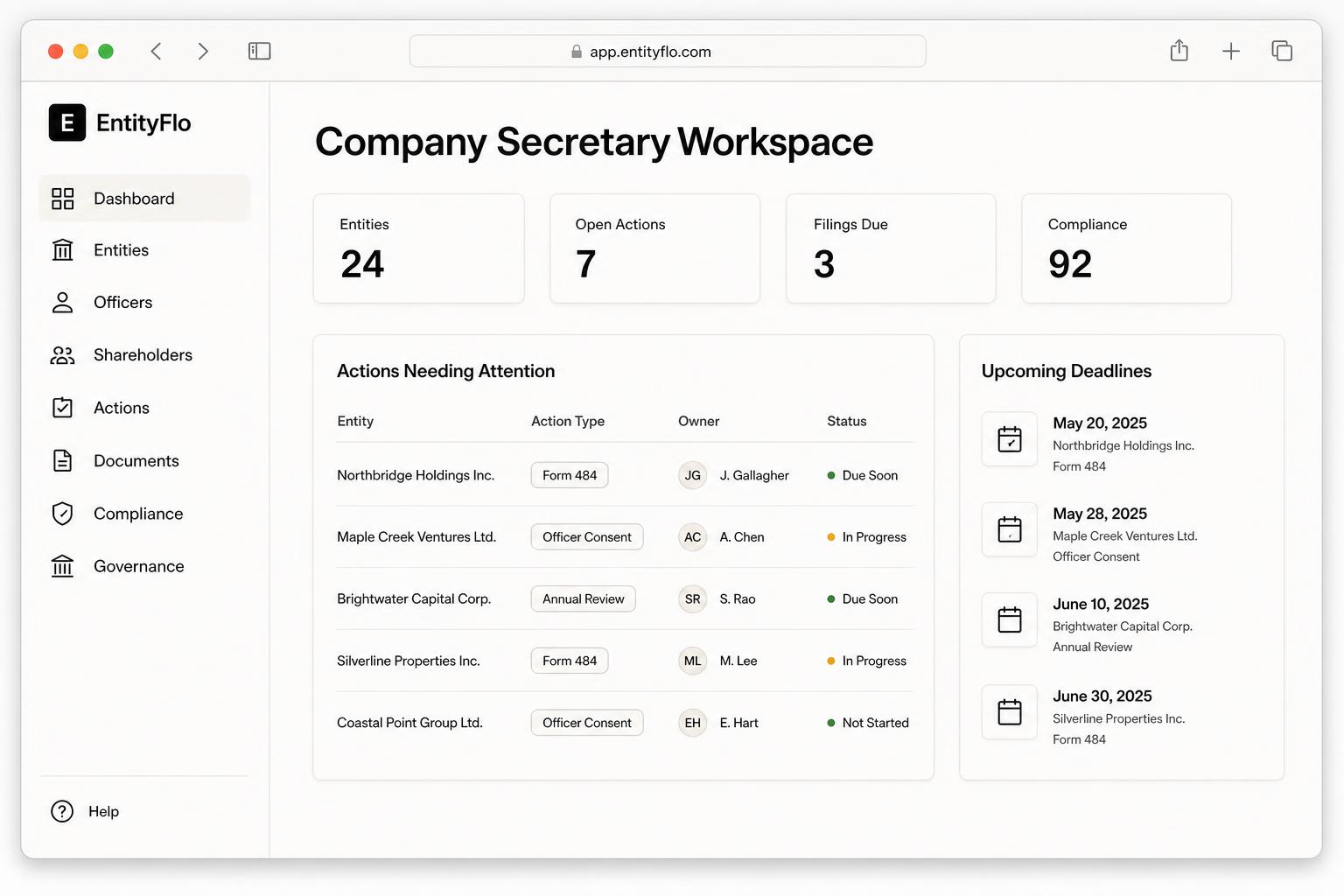
EntityFlo's obligation monitoring provides advance alerts before deadlines arrive, not notifications after they've passed. The system calculates upcoming obligations across the entire portfolio and surfaces them in the compliance dashboard with clear due dates, entity context, and severity ratings. The compliance calendar provides a forward-looking view of obligations across all entities, enabling governance teams to plan their workload proactively. Obligations can be filtered by entity, type, due date, and status, making it easy to focus on the most urgent items or to review all obligations for a specific entity. For organisations with regular recurring obligations — such as quarterly BAS lodgements or annual review cycles — EntityFlo tracks the recurring pattern and ensures each instance is monitored independently.
Renewal Management
Renewals — business names, trading names, licences, insurance policies, and professional registrations — represent a significant subset of obligations that require specific tracking. Unlike one-time obligations, renewals recur on defined cycles and often require payment, documentation, and verification at each renewal point. EntityFlo tracks renewal dates, costs, and documentation requirements for every renewable item across the portfolio. Advance alerts ensure that renewal actions are initiated well before expiry, avoiding the lapsed registration and coverage gaps that can create business risk. The compliance engine flags expired or soon-to-expire renewals with appropriate severity ratings. For insurance policies, EntityFlo tracks policy limits, coverage types, and renewal dates, ensuring that the organisation maintains adequate insurance coverage across all entities. For licences, the platform tracks issuing authorities, conditions, and renewal requirements.
Resolution and Audit Trail
Every obligation in EntityFlo supports the universal action pattern — create a formal action, mark as complete, or mark as not applicable. This consistent resolution framework ensures that obligations are addressed through structured workflows rather than ad hoc processes. When an obligation is resolved, the completion is recorded with timestamps, user identity, and any supporting documentation. This audit trail demonstrates that obligations were identified, tracked, and addressed — valuable evidence for regulatory inquiries, audits, and governance reviews. The obligations history tab provides a complete record of all obligations that have been tracked, completed, or dismissed, with the ability to filter by date range, entity, and resolution type. This historical record supports compliance reporting and demonstrates the organisation's systematic approach to obligation management.
Why EntityFlo for Obligation Tracking
EntityFlo provides obligation tracking that is integrated with entity management, compliance monitoring, and governance workflows. Unlike standalone reminder tools that require manual obligation setup and maintenance, EntityFlo derives obligations automatically from entity data and tracks them within the broader compliance framework. With automated detection, proactive alerts, integrated resolution workflows, and complete audit trails, EntityFlo ensures that every obligation across every entity is visible, tracked, and addressed. For corporate groups where the volume of obligations makes manual tracking impossible, EntityFlo provides the automated infrastructure that prevents missed deadlines and their costly consequences.
Explore related features
See how EntityFlo connects across the platform.
Frequently asked questions
What types of obligations does EntityFlo track?
EntityFlo tracks ASIC annual reviews, BAS lodgement deadlines, business name renewals, licence renewals, insurance policy renewals, trust deed reviews, solvency resolution requirements, and other entity-specific obligations.
Are obligations created automatically?
Yes. EntityFlo derives obligations from entity data automatically — when entities are created, licences are added, or registration dates are updated, relevant obligations are generated without manual setup.
How far in advance does EntityFlo alert for deadlines?
EntityFlo provides configurable advance alerts and surfaces upcoming obligations in the compliance dashboard and calendar, enabling governance teams to plan workload proactively.
Can I track obligations across all entities at once?
Yes. The compliance dashboard and calendar provide portfolio-wide views of all obligations, filterable by entity, type, due date, and status for efficient group-wide management.
Take control of your entity portfolio.
Your first entity is free. No credit card, no lock-in. Set up in under 15 minutes.
Entity Register
Every entity, officer and shareholder in one live register.
ExploreGovernance Workflows
From board decision to registered outcome. Every step tracked.
ExploreCompliance Engine
Continuous compliance monitoring across every entity.
ExploreStructure & Ownership
Live structure charts, ownership chains and UBO traces across the group.
ExploreBoardroom
Run board meetings, papers, resolutions and minutes from one place.
ExploreFloSec AI
Your AI Company Secretary across every record, action and obligation.
ExploreWe use cookies to improve your experience. Essential cookies are always active. You can accept all cookies or choose essential only.