ASIC Compliance Software: What Australian Companies Need in 2026
ASIC compliance is an ongoing obligation for every registered Australian company. This guide explains what ASIC compliance software does, what to look for, and how EntityFlo automates registry sync, deadline tracking, and direct ASIC lodgement for multi-entity portfolios.
Introduction
ASIC compliance is not optional, and it's not simple.
Every registered Australian company has ongoing obligations under the Corporations Act 2001 (Cth) — annual reviews, change notifications, register maintenance, and lodgement deadlines that don't move because you forgot. For companies managing multiple entities, the administrative burden compounds quickly.
ASIC compliance software is the category of tools designed to automate, track, and audit this work. In 2026, the question for most corporate groups isn't whether to use software — it's which platform fits your obligations, your team, and the scale of your portfolio.
This guide explains what ASIC compliance software does, what to look for in the Australian regulatory context, and how EntityFlo approaches it differently from traditional accounting-firm tools.
What ASIC Compliance Actually Covers
ASIC administers the Corporations Act and maintains the national business registry. Your obligations as a company officer include:
Annual Reviews
Every registered Australian company receives an annual review notice from ASIC. The review fee must be paid within 28 days. Companies that miss this deadline trigger late payment penalties under section 1351 of the Corporations Act. For a group managing 30 entities with staggered review dates, missing even two or three per year adds up fast.
Change Notifications
When your company changes:
- Directors or secretaries — lodge Form 484 within 28 days
- Registered address — lodge Form 484 within 28 days
- Company name — requires a special resolution and Form 205
- Share structure — changes to issued capital and shareholdings require notifications under Chapter 2C of the Corporations Act
Register Maintenance
Companies must maintain accurate internal registers of:
- Members (shareholders) under section 169
- Officeholders (directors, secretaries, public officers)
- Charges over company property under Part 2K of the Corporations Act
These registers must be available for inspection by members and regulators.
Beneficial Ownership Reporting
Expanded obligations under AUSTRAC guidance and the Anti-Money Laundering and Counter-Terrorism Financing Act 2006 require many Australian companies to document and report their beneficial ownership chains — particularly those with trust structures, nominee arrangements, or complex cross-shareholdings.
What ASIC Compliance Software Does
Purpose-built ASIC compliance software handles the full lifecycle of your regulatory obligations:
1. Registry Sync
Pull live company data directly from ASIC's registry — directors, addresses, share structure, filing history. The best platforms sync automatically and flag discrepancies between what ASIC holds and your internal records.
2. Deadline Tracking and Alerts
Automated monitoring of every annual review date, lodgement deadline, and change notification window across your entire entity portfolio. Smart alerts notify the right person before deadlines become penalties.
3. Direct ASIC Lodgement
Platforms certified as ASIC Digital Service Providers (DSP) can lodge documents directly with ASIC's electronic registry — Form 484, Form 201, Form 362, and others — without manual portal login or re-keying of data.
4. Compliance Health Scoring
An aggregated view of your portfolio's compliance status. Which entities are current? Which have outstanding actions? Which are at risk? A health score across your full portfolio is infinitely more useful than manually checking each entity.
5. Audit Trail
Every change to your entity data is logged: who changed it, when, and what the previous value was. This is the record that protects you when ASIC or an auditor asks how your register has been maintained.
The Cost of Non-Compliance
Late lodgement penalties under section 1351 of the Corporations Act:
| Lodgement timing | Penalty (2024 rates) | |
|---|---|---|
| Up to 1 month late | $82 per document | |
| More than 1 month late | $341 per document |
For a corporate group with 20 entities and two or three missed deadlines per year, that's $500–$2,000 in avoidable fees annually. Add the cost of the Company Secretary's time to remediate — and the opportunity cost of not catching issues earlier — and the real cost of non-compliance is substantially higher.
Beyond fines: persistent non-compliance can result in ASIC initiating the deregistration of your company. For a special purpose vehicle or trust that holds real assets, deregistration has serious consequences.
ASIC Compliance Software vs Accountant-Managed Compliance
Most Australian companies delegate some ASIC compliance to their accountant or registered agent. This works well for single entities or simple structures. For groups with 5+ entities, it has limitations:
| Accountant-managed | In-house software (EntityFlo) | ||
|---|---|---|---|
| Real-time ASIC sync | ❌ Periodic only | ✅ Live | |
| Compliance status visibility | 🟡 On request | ✅ Dashboard | |
| Deadline alerts | 🟡 Depends on accountant | ✅ Automated | |
| Internal team access | ❌ Adviser-only | ✅ CFO/Company Sec direct access | |
| ASIC lodgement fee | Extra charge per document | ✅ Included in subscription | |
| Audit trail | 🟡 In accountant's system | ✅ In your system | |
| Available 24/7 | ❌ | ✅ |
The model isn't binary — many organisations use EntityFlo alongside their accountant, with the accountant retained for advice and the in-house team managing day-to-day compliance visibility.
What to Look for When Evaluating ASIC Compliance Software
DSP Certification
Only purchase from a platform that holds ASIC Digital Service Provider certification. This means ASIC has validated the platform's integration and authorised it for electronic lodgement. EntityFlo is a certified ASIC DSP.
Multi-Entity Portfolio Management
If you're managing more than one company, the platform must handle your entire portfolio — not entity-by-entity logins. You need a single compliance view across all entities.
Australian Regulatory Scope
Some governance platforms are built for the US or UK market and retrofitted for Australia. ASIC integration, Corporations Act workflows, and AU-specific form types are non-negotiable. Check specifically: does the platform handle Australian annual reviews? Does it support Form 484 natively?
Data Residency
Company data — especially beneficial ownership and director details — should be stored in Australia. Check the provider's data residency policy before signing up.
Pricing Transparency
ASIC lodgements should not be billed per document. Platforms that charge per lodgement create a disincentive to keep records current. EntityFlo includes all ASIC lodgements in the subscription at no extra charge.
How EntityFlo Handles ASIC Compliance
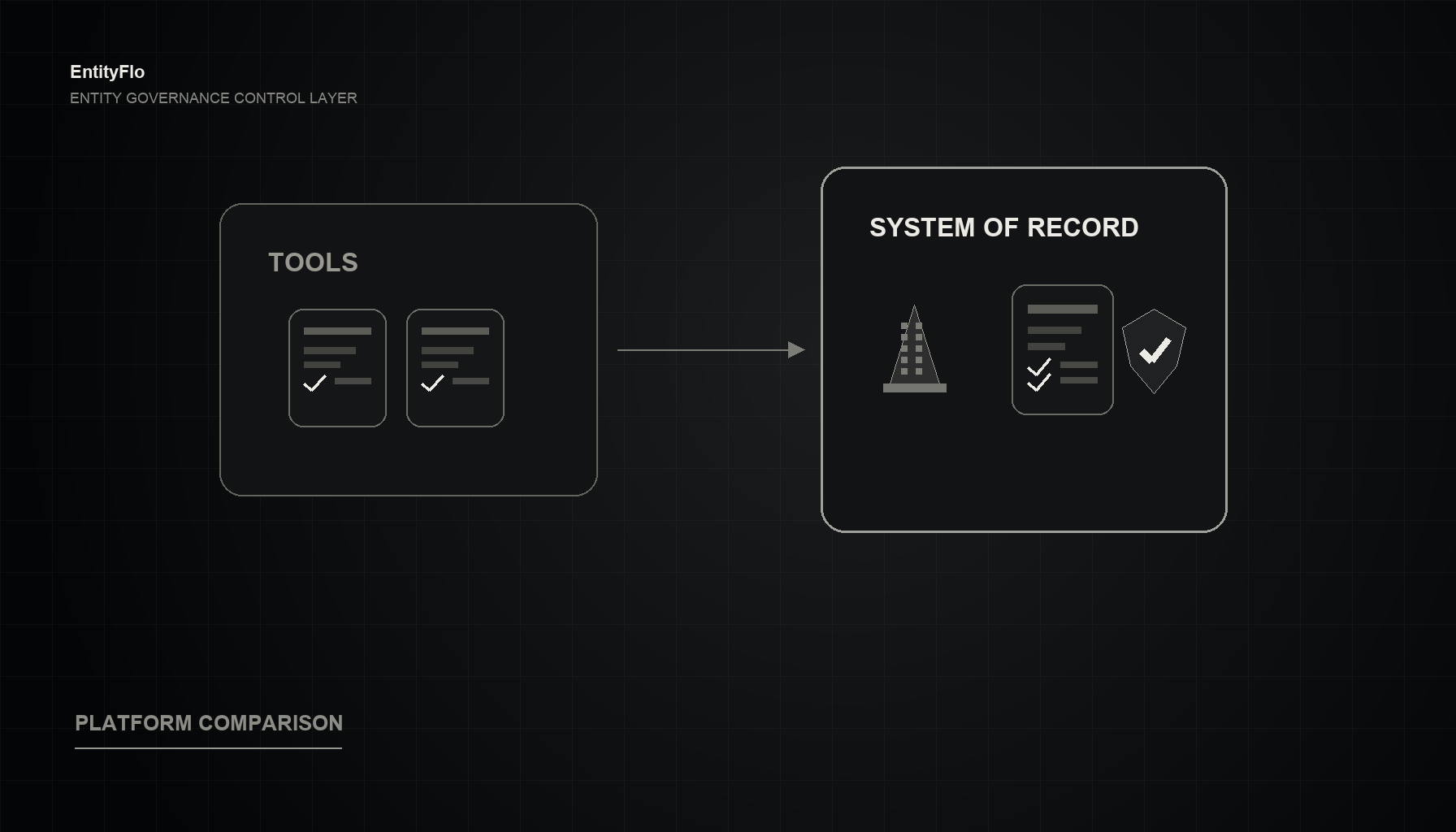
EntityFlo was built specifically for Australian companies managing multi-entity portfolios in-house — not for accounting firms managing client registers.
[RegistryConnect](/blog/registryconnect-revolution-digital-filing-no-longer-compliance) syncs live ASIC data for every entity in your portfolio, surfacing discrepancies between ASIC's records and your internal data automatically.
Compliance Health Score gives every entity a red/amber/green status based on outstanding actions, upcoming deadlines, and register accuracy. Your portfolio dashboard shows the full picture at a glance.
Deadline Engine tracks every annual review date, lodgement window, and regulatory obligation — with automated alerts to the assigned owner before deadlines are missed.
FloSec AI analyses your compliance position, drafts lodgement-ready ASIC forms, and flags risks that a static register would miss entirely.
Direct ASIC Lodgement — as a certified DSP, EntityFlo can lodge Form 484 and other documents directly with ASIC from within the platform. No portal login. No re-keying. Included in every plan.
Frequently Asked Questions
What happens if I miss an ASIC annual review?
ASIC will issue a reminder, but if the fee remains unpaid 28 days after the review date, late fees apply under section 1351. If fees remain unpaid for an extended period, ASIC may initiate deregistration proceedings. EntityFlo alerts you before this happens.
Can EntityFlo replace my company's registered agent?
EntityFlo handles the compliance tracking, register maintenance, and ASIC lodgement functions typically performed by registered agents or accountants. For companies with straightforward structures, this is fully manageable in-house. For complex advisory needs, EntityFlo works alongside your accountant.
How does EntityFlo's ASIC sync work?
EntityFlo connects to ASIC's registry via the DSP integration and syncs entity data — directors, addresses, share structure, filing history — automatically. Any discrepancy between ASIC's records and your internal data is flagged in your dashboard.
Is ASIC compliance software worth it for a company with 3-4 entities?
For 1-4 entities with simple structures, an accountant typically handles this cost-effectively. The inflection point is usually around 5+ entities, or any structure with beneficial ownership complexity. EntityFlo's Foundation plan starts at $199/month and covers up to 25 entities.
Summary
ASIC compliance is a continuous obligation, not a once-a-year task. For companies managing multiple entities, the combination of staggered review dates, ongoing change notifications, and register accuracy requirements creates a compliance operation that manual tools can't reliably support.
Purpose-built ASIC compliance software — with live registry sync, automated deadline tracking, and direct lodgement capability — turns this from a liability into a managed process.
See how EntityFlo handles ASIC compliance for your portfolio.
Start your 14-day free trial — no credit card required.
Book a demo — 30 minutes, focused on your structure.
Nathan Carroll is the founder and CEO of EntityFlo, Australia's purpose-built [entity management platform](/) for corporate groups, family offices, and [property developers](/blog/entity-management-property-developers-australia) managing 5–100 entities. Prior to EntityFlo, Nathan held the role of Global CRO at FeeWise (LEAP/InfoTrack group), scaling North American revenue from zero to $1M+ ARR in 12 months. He has completed two company exits, including Antler's first global exit. [Connect on LinkedIn](https://linkedin.com/in/nathan-carroll-32b98231).