The Easiest Way to Stay Ahead of the UBO Curve in 2026
Australia's UBO disclosure requirements are tightening. Most corporate groups treat beneficial ownership as a one-time exercise — but ownership structures change constantly. Here's why live AI-powered UBO monitoring is the only model that keeps you continuously compliant.
Australia's UBO disclosure requirements are tightening. Most corporate groups think they've done the work. They haven't.
What UBO Actually Means in Australia (and Why It's More Complex Than Most Think)
UBO — Ultimate Beneficial Ownership — refers to the real, natural person who ultimately owns or controls a company, trust, or corporate structure. In Australia, beneficial ownership disclosure has historically lived in AML/CTF obligations for reporting entities, but the landscape is shifting fast.
AUSTRAC's Tranche 2 AML/CTF reforms are bringing lawyers, accountants, real estate agents and other professional service providers under formal AML/CTF obligations for the first time. And with that comes expanded UBO disclosure requirements — including the need to identify, verify, and monitor the ultimate beneficial owners behind corporate clients.
What makes UBO complex in Australia is the layered nature of corporate structures. It's rarely a single company with a single shareholder. It's a holding company, owned by a discretionary trust, with a corporate trustee, controlled by a natural person who may also sit behind another holding entity. Tracing ownership through those layers — accurately and continuously — is where most compliance exercises fall apart.
Why a One-Time UBO Exercise Isn't Enough
Here's the core problem: most organisations treat UBO compliance as a project. They map out their structures, build their beneficial ownership register, tick the box — and then don't revisit it for 12, 18, 24 months.
But corporate structures don't stay still.
New investors come in. A trust deed gets varied. A director steps down and a new one steps up who turns out to be a beneficial owner through another entity. A holding company restructure changes the chain of ownership across an entire group. Each of these events potentially changes who the ultimate beneficial owners are — and your register is now wrong.
The groups that get caught out on UBO compliance aren't the ones who ignored it entirely. They're the ones who did the work once and never updated it.
The AML/CTF Reform Pressure — Tranche 2 Is Coming
The Anti-Money Laundering and Counter-Terrorism Financing Amendment Act 2024 is the most significant reform to Australia's AML/CTF framework in nearly two decades. Tranche 2 brings an estimated 100,000 additional businesses under the AML/CTF Act — and UBO disclosure sits at the centre of the new obligations.
For professional service firms now becoming reporting entities, the requirement to know your customer goes deeper than a name and an ABN. You need to identify the beneficial owners — the real people — behind corporate clients. And you need to keep that information current.
For corporate groups themselves, the expectation from regulators, lenders, investors, and counterparties is moving in one direction: continuous, verifiable, up-to-date beneficial ownership disclosure. The compliance bar is rising whether you're a reporting entity or not.
What "Staying Ahead" Actually Looks Like Operationally
Staying ahead of the UBO curve isn't about doing a better job of the one-time exercise. It's about changing the model entirely.
Instead of a periodic UBO review, you need continuous monitoring — a system that watches your corporate structures in real time and flags changes that affect beneficial ownership before they become compliance gaps.
That means:
- Automated ownership tracing through layered structures — Pty Ltd, unit trusts, discretionary trusts, partnerships — following the chain to the natural person at the end
- Change detection — when a share transfer occurs, when a trust deed variation is recorded, when a new officeholder is appointed, the system updates beneficial ownership accordingly
- Live register maintenance — your beneficial ownership register reflects current reality, not last year's snapshot
- Audit-ready documentation — every change is logged, every trace is documented, every ownership chain can be exported and verified
This is what live UBO monitoring looks like. And it's the only model that keeps you continuously compliant as your structures evolve.
How EntityFlo Traces UBO Automatically Through Layered Structures
EntityFlo's AI governance layer was built for exactly this problem.
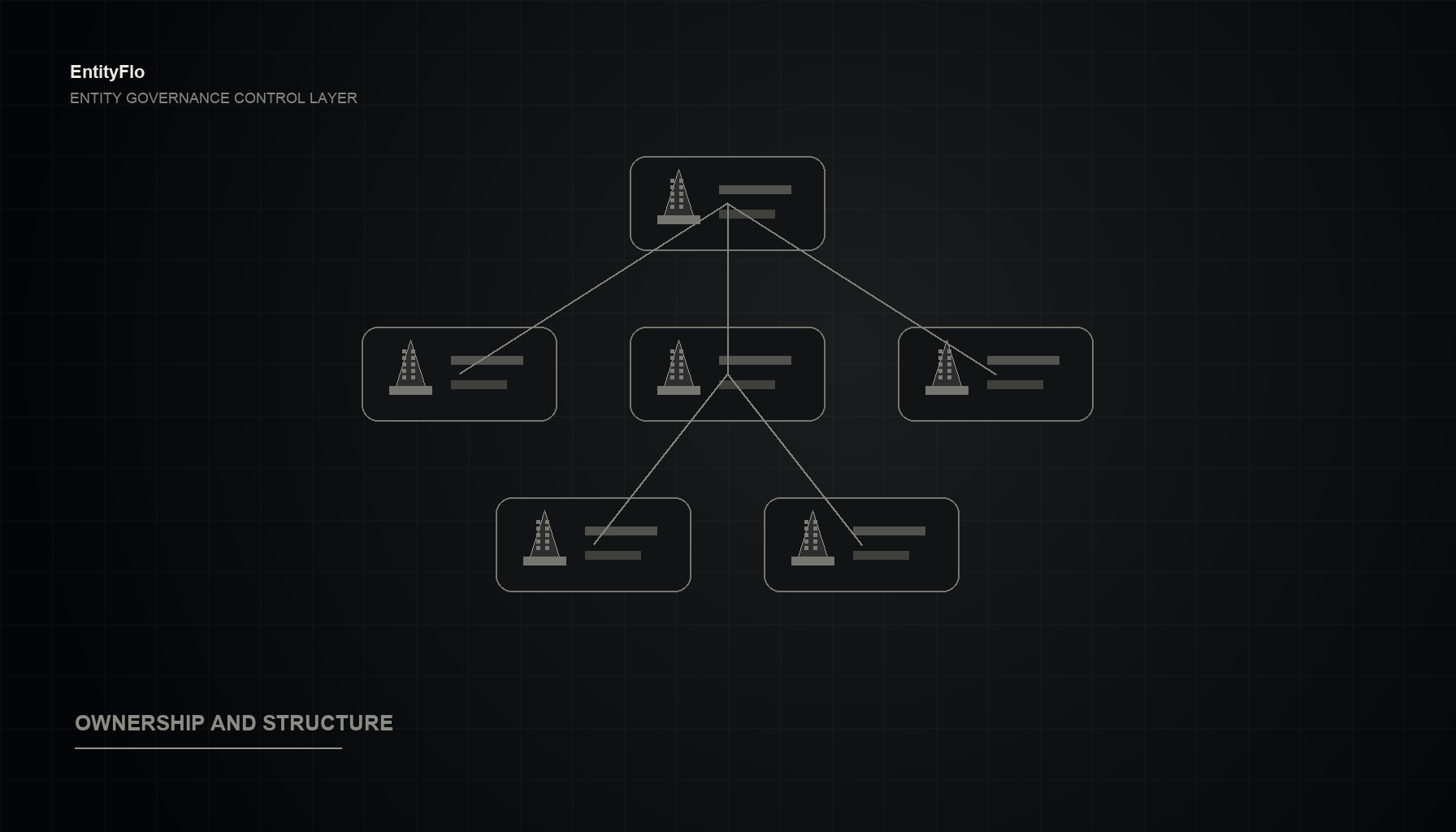
When you connect your corporate group to EntityFlo, it maps the ownership structure — every entity, every trust, every officeholder, every shareholder — and traces the beneficial ownership chain through the layers to identify the ultimate natural persons in control.
As your structures change, EntityFlo's monitoring engine picks up the changes and updates the beneficial ownership trace automatically. New ASIC filings, updated trust deeds, ownership changes — the system keeps the register current without someone having to manually chase updates across multiple entities.
The beneficial ownership data is always available — as a live view across the group, exportable for AML/CTF due diligence requests, ready for regulator inquiries, and visible to your compliance team in real time.
For groups managing 10, 50, or 200+ entities, this is the only model that scales. Manual UBO maintenance across a large corporate group isn't just inefficient — it's a compliance liability.
What to Do This Week to Get Ahead of the Curve
If you're managing a corporate group and haven't reviewed your UBO position recently, here's where to start:
- Audit your current register — when was it last updated? Does it reflect actual ownership as of today?
- Map your structure changes — what has changed in the past 12 months? New investors? Trust variations? Holding company restructures?
- Assess your Tranche 2 exposure — if your firm provides professional services, understand your new AML/CTF obligations and when they take effect
- Move to continuous monitoring — commit to a model where UBO tracking is ongoing, not periodic
- Get EntityFlo working for your group — let the AI do the tracing and the monitoring, so your team can focus on the decisions, not the data maintenance
The groups that are ahead of the UBO curve in 2026 are the ones who changed their model from "project" to "live system." The window to do that before Tranche 2 hits is narrowing.
FAQs
What is UBO in Australia?
UBO stands for Ultimate Beneficial Owner — the natural person who ultimately owns or controls a company, trust, or corporate structure. In Australia, UBO identification and disclosure is required under AML/CTF law for reporting entities and is increasingly expected across corporate governance and due diligence contexts.
Who needs to disclose beneficial ownership?
Reporting entities under the AML/CTF Act are required to identify and verify beneficial owners as part of their Know Your Customer (KYC) obligations. Under Tranche 2 reforms, this will extend to lawyers, accountants, real estate agents, and other professional service providers. Corporate groups are also increasingly required to disclose UBO to lenders, investors, and counterparties.
How does Tranche 2 AML/CTF affect UBO requirements?
Tranche 2 brings approximately 100,000 additional businesses under AML/CTF obligations, including professional service firms that were previously exempt. These entities will be required to implement AML/CTF programs including customer due diligence and beneficial ownership identification. UBO disclosure becomes a formal compliance requirement for a much broader set of organisations.
Can AI automate UBO monitoring?
Yes. AI-powered tools like EntityFlo can trace beneficial ownership automatically through layered corporate structures, detect changes that affect ownership, update beneficial ownership registers in real time, and provide audit-ready documentation. This replaces manual, periodic UBO reviews with continuous, live monitoring.