Corporate Structure Software Australia
Your corporate structure is a living organism — entities are added, restructured, and retired constantly. EntityFlo maintains the definitive map of your group structure with automated charts, ownership tracking, and compliance monitoring.
Your first entity is free. No credit card required.
Corporate Structure Software Australia
Your corporate structure is a living organism — entities are added, restructured, and retired constantly. EntityFlo maintains the definitive map of your group structure with automated charts, ownership tracking, and compliance monitoring.
Join BetaThe Corporate Structure Challenge
Every corporate group has a structure — the web of entities, ownership relationships, and governance connections that define how the group is organised. For mid-market Australian groups, this structure typically includes holding companies, operating subsidiaries, special purpose vehicles, family trusts, unit trusts, and partnerships, all connected through shareholdings, trustee appointments, and beneficial ownership relationships. The challenge is that corporate structures are not static. Entities are incorporated and deregistered. Ownership is transferred between group members. New subsidiaries are created for specific purposes. Trust structures are established for asset protection or succession planning. Each change affects the group structure and creates governance, compliance, and reporting obligations that must be managed. Most organisations track their corporate structure in static diagrams — PowerPoint slides, Visio files, or wall charts that are updated sporadically and often reflect what the structure looked like months or years ago rather than what it looks like today.
Dynamic Structure Management
EntityFlo provides dynamic corporate structure management that maintains an always-current representation of the group. Every entity, ownership relationship, and governance connection is recorded in the platform's data model, and the structure chart is generated automatically from this data. When ownership changes, entities are added or removed, or governance relationships evolve, the structure representation updates immediately. This dynamic approach eliminates the maintenance burden of static diagrams and ensures that anyone accessing the structure chart sees the current reality. Board members reviewing the group structure in a governance meeting see exactly the same data that the company secretary used to prepare the board papers — because both are drawing from the same live data source. The structure management capability extends beyond visualisation to include entity lifecycle management. New entities can be onboarded with their place in the group structure defined from the start. Dormant entities can be flagged without being removed from the structure. Entities undergoing closure are tracked through the deregistration process within the structural context.
Multi-Entity Governance at Scale
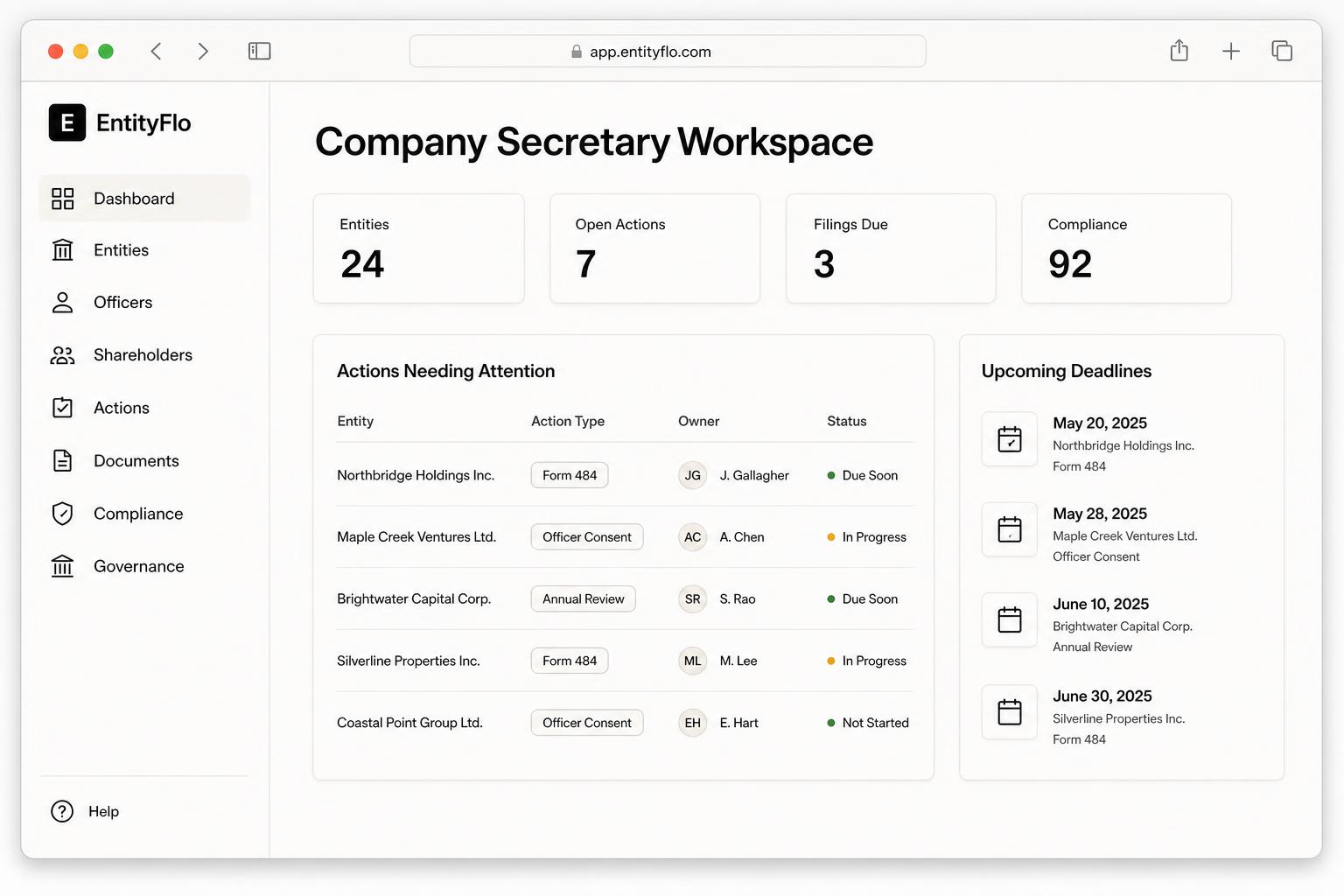
Corporate structure software must support governance at scale. For a group with thirty entities, maintaining compliance across all entities requires tracking hundreds of obligations, dozens of officers, complex ownership chains, and multiple regulatory relationships. EntityFlo provides the infrastructure to manage this scale efficiently. Group-wide dashboards show governance health across all entities, highlighting those that need attention. Cross-entity search enables quick location of specific officers, documents, or compliance items regardless of which entity they relate to. Bulk operations allow common actions to be performed across multiple entities simultaneously — essential for group-wide officer changes, policy rollouts, or compliance campaigns. The compliance engine assesses each entity independently and aggregates results into group-level health scores, providing both entity-specific and portfolio-wide views of governance performance. This multi-level visibility ensures that individual entity issues are addressed while maintaining oversight of the group's overall governance posture.
Entity Classification and Grouping
Not all entities in a corporate group serve the same purpose. Operating companies, holding companies, special purpose vehicles, dormant entities, and trust structures each have different governance requirements, compliance obligations, and management attention needs. EntityFlo supports entity classification and grouping that reflects how governance teams actually organise their work. Client groups enable organisations to organise entities by purpose, business unit, geography, or any other relevant categorisation. Each group can have its own colour coding, description, and sorting order, making it easy to navigate large portfolios and identify entities by their role in the group structure. Entity type classification ensures that governance workflows are appropriate for each structure type. Company-specific workflows (ASIC filings, share register maintenance) are applied to companies. Trust-specific workflows (deed reviews, trustee changes, beneficiary management) are applied to trusts. This type-aware governance ensures that every entity receives the correct compliance treatment regardless of the portfolio's structural diversity.
Restructuring and Structural Change
Corporate restructurings — mergers, demergers, share transfers between group entities, trust variations, and entity closures — are complex governance events that affect multiple entities simultaneously. EntityFlo supports these events through multi-entity action workflows that coordinate the governance, compliance, and documentary requirements across all affected entities. When shares are transferred from one group entity to another, EntityFlo updates ownership records at both entities, recalculates beneficial ownership across the group, adjusts compliance assessments, and generates the required ASIC filings. The structure chart updates automatically to reflect the new ownership arrangement. This coordinated approach to structural change ensures that restructuring events are managed comprehensively rather than entity by entity, reducing the risk of incomplete implementations where some entities are updated but others are missed.
Why EntityFlo for Corporate Structure
EntityFlo provides the definitive corporate structure management platform for Australian groups. Unlike generic tools that require manual structure maintenance, EntityFlo generates and maintains the structure automatically from live entity and ownership data. Unlike standalone diagramming tools, EntityFlo integrates structure visualisation with governance, compliance, and beneficial ownership management. For organisations whose corporate structure is a strategic asset — enabling tax efficiency, asset protection, risk isolation, and governance clarity — EntityFlo provides the management infrastructure that keeps the structure accurate, compliant, and comprehensible. From initial entity incorporation to eventual group simplification, EntityFlo maintains the definitive record of what your corporate group looks like, who owns what, and how it all fits together.
Explore related features
See how EntityFlo connects across the platform.
Frequently asked questions
Does EntityFlo automatically generate structure charts?
Yes. EntityFlo generates interactive structure charts automatically from your entity and ownership data, updating in real time as the corporate structure changes.
Can EntityFlo manage both companies and trusts?
Yes. EntityFlo supports companies, trusts, partnerships, and other entity types with type-specific governance workflows and compliance requirements for each structure.
How does EntityFlo handle corporate restructurings?
EntityFlo coordinates multi-entity workflows for restructurings, updating ownership records, beneficial ownership calculations, compliance assessments, and ASIC filings across all affected entities simultaneously.
Can I organise entities into custom groups?
Yes. EntityFlo supports client grouping by purpose, business unit, geography, or any other categorisation, with colour coding and custom sorting for easy portfolio navigation.
Take control of your entity portfolio.
Your first entity is free. No credit card, no lock-in. Set up in under 15 minutes.
Entity Register
Every entity, officer and shareholder in one live register.
ExploreGovernance Workflows
From board decision to registered outcome. Every step tracked.
ExploreCompliance Engine
Continuous compliance monitoring across every entity.
ExploreStructure & Ownership
Live structure charts, ownership chains and UBO traces across the group.
ExploreBoardroom
Run board meetings, papers, resolutions and minutes from one place.
ExploreFloSec AI
Your AI Company Secretary across every record, action and obligation.
ExploreWe use cookies to improve your experience. Essential cookies are always active. You can accept all cookies or choose essential only.