Governance, Risk and Compliance Software Australia
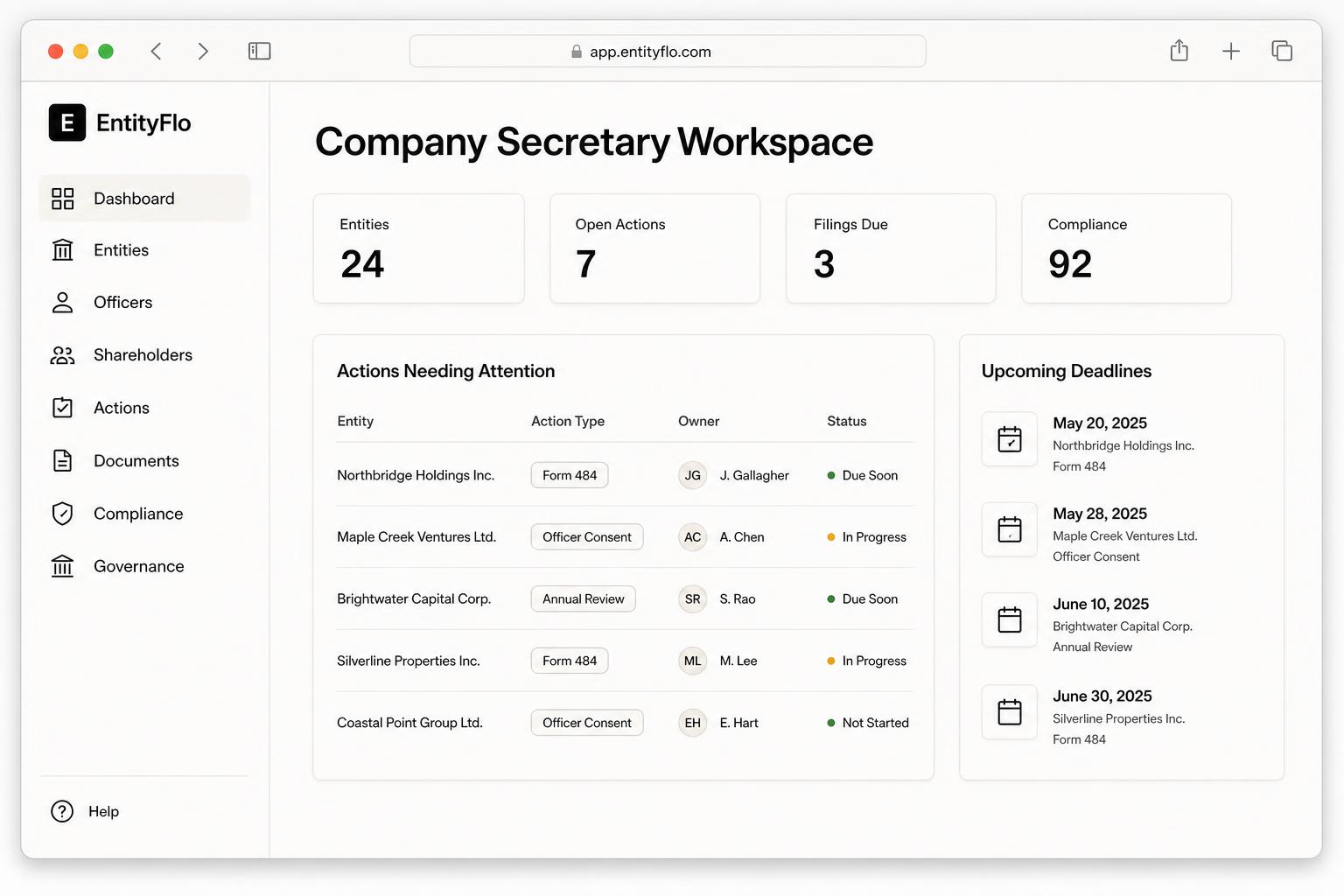
Governance, risk, and compliance shouldn't live in three different systems. EntityFlo unifies GRC for corporate groups — automating compliance, embedding governance in workflows, and surfacing risk before it becomes a problem.
Your first entity is free. No credit card required.
Governance, Risk and Compliance Software Australia
Governance, risk, and compliance shouldn't live in three different systems. EntityFlo unifies GRC for corporate groups — automating compliance, embedding governance in workflows, and surfacing risk before it becomes a problem.
Join BetaThe GRC Challenge for Corporate Groups
Governance, Risk, and Compliance (GRC) represents the three pillars of organisational integrity. Governance defines how decisions are made and accountability is maintained. Risk identifies threats to objectives and establishes controls. Compliance ensures the organisation meets its legal and regulatory obligations. For corporate groups managing multiple entities, these pillars must operate consistently across the entire structure. Traditionally, GRC functions are managed in silos — governance through board portals and minute books, risk through risk registers and heat maps, compliance through obligation trackers and audit schedules. This fragmentation creates blind spots where governance decisions create compliance risks, compliance obligations reveal governance gaps, and risk assessments are disconnected from both. For mid-market organisations without enterprise GRC budgets, the fragmentation is even more pronounced.
Integrated GRC Through Entity Management
EntityFlo approaches GRC through the lens of entity management — recognising that every governance decision, compliance obligation, and risk factor is anchored to specific entities in the corporate structure. This entity-centric model naturally integrates the three pillars because each entity's governance, compliance, and risk profile is managed in one place. A board resolution to appoint a new director (governance) automatically triggers compliance tracking for consent forms and ASIC filings (compliance) while updating the entity's officer profile for risk assessment purposes (risk). A missed annual review deadline (compliance) surfaces in the governance dashboard as a compliance gap (governance) and in the risk profile as regulatory exposure (risk). This integration happens automatically because EntityFlo's data model connects governance events, compliance obligations, and risk indicators to the entities they affect. There's no manual reconciliation between systems — the relationships are inherent in the platform architecture.
Governance Management
EntityFlo's governance layer manages the decision-making infrastructure of the corporate group. Board meetings, resolutions, circular approvals, and committee decisions are all tracked with full context — participants, voting outcomes, supporting documents, and downstream actions. The resolution register provides a complete chronological record of every formal decision across the group. Conflict of interest management ensures that director interests are disclosed, assessed, and managed according to established policies. Delegation authorities define decision-making boundaries across the group structure. And the governance calendar ensures that board meetings, committee reviews, and governance processes are conducted on schedule. The governance health score provides a quantitative measure of governance quality for each entity, enabling boards and executives to monitor governance performance across the portfolio objectively.
Compliance Automation
EntityFlo's compliance engine continuously monitors eight categories of compliance requirements across every entity in the portfolio. Officers and appointments, identity and screening, ownership and UBO, governing documents, registers and records, annual compliance, renewals and licences, and closure and exit are all assessed automatically. Each compliance requirement is categorised by severity — critical, warning, or low — with corresponding score impacts that roll up into entity and group-level compliance health scores. Issues are surfaced with actionable remediation guidance, and the universal action pattern provides consistent resolution workflows across all compliance categories. As a integrated with ASIC, EntityFlo integrates compliance monitoring with regulatory filing capabilities. When compliance issues relate to missing or overdue ASIC filings, remediation can include direct lodgement through the platform, closing the loop from issue identification to regulatory resolution.
Risk Visibility Through Data
EntityFlo provides risk visibility through the data it captures across governance and compliance activities. The compliance health dashboard surfaces entities with low governance scores, highlighting areas of concentrated risk. Beneficial ownership tracking identifies complex ownership structures where transparency risk may exist. Officer management shows where key-person dependencies exist across the group. The compliance trend analysis shows whether governance health is improving or deteriorating over time, enabling proactive risk management rather than reactive issue resolution. And the activity log provides an audit trail that demonstrates governance processes are being followed — reducing regulatory and reputational risk. While EntityFlo is not a traditional risk register tool, it provides the entity-level governance and compliance data that informs risk assessment and supports risk management decision-making for corporate groups.
Why EntityFlo for GRC
EntityFlo delivers integrated GRC capability without the complexity and cost of enterprise GRC platforms. By anchoring governance, compliance, and risk management to entity records, EntityFlo provides natural integration between the three pillars — no middleware, no manual reconciliation, no separate systems to maintain. Purpose-built for Australian corporate groups, EntityFlo understands the regulatory environment, governance requirements, and compliance obligations that Australian organisations face. Combined with ASIC integration, AI-native governance support, and comprehensive audit trails, EntityFlo provides the GRC infrastructure that mid-market organisations need to govern effectively, comply consistently, and manage risk proactively.
Explore related features
See how EntityFlo connects across the platform.
Frequently asked questions
What is GRC software?
GRC (Governance, Risk, and Compliance) software is a platform that integrates the management of governance processes, risk assessment, and compliance obligations to provide a unified view of organisational integrity.
How does EntityFlo integrate GRC?
EntityFlo integrates GRC through its entity-centric data model, where every governance decision, compliance obligation, and risk indicator is anchored to specific entities — creating natural connections between the three pillars.
Is EntityFlo an enterprise GRC platform?
EntityFlo provides integrated GRC capabilities purpose-built for mid-market corporate groups, delivering governance, compliance, and risk visibility without the complexity of enterprise GRC platforms.
Does EntityFlo include a risk register?
EntityFlo provides risk visibility through governance health scores, compliance trend analysis, and beneficial ownership tracking, surfacing entity-level risk indicators that inform risk management decisions.
Take control of your entity portfolio.
Your first entity is free. No credit card, no lock-in. Set up in under 15 minutes.
Entity Register
Every entity, officer and shareholder in one live register.
ExploreGovernance Workflows
From board decision to registered outcome. Every step tracked.
ExploreCompliance Engine
Continuous compliance monitoring across every entity.
ExploreStructure & Ownership
Live structure charts, ownership chains and UBO traces across the group.
ExploreBoardroom
Run board meetings, papers, resolutions and minutes from one place.
ExploreFloSec AI
Your AI Company Secretary across every record, action and obligation.
ExploreWe use cookies to improve your experience. Essential cookies are always active. You can accept all cookies or choose essential only.