ASIC RegistryConnect: What It Means for Corporate Secretaries and Compliance Teams
ASIC is upgrading its company register with new APIs for Digital Service Providers in 2026. Here's what corporate secretaries and compliance teams need to know — and the questions to ask your entity management software provider now.
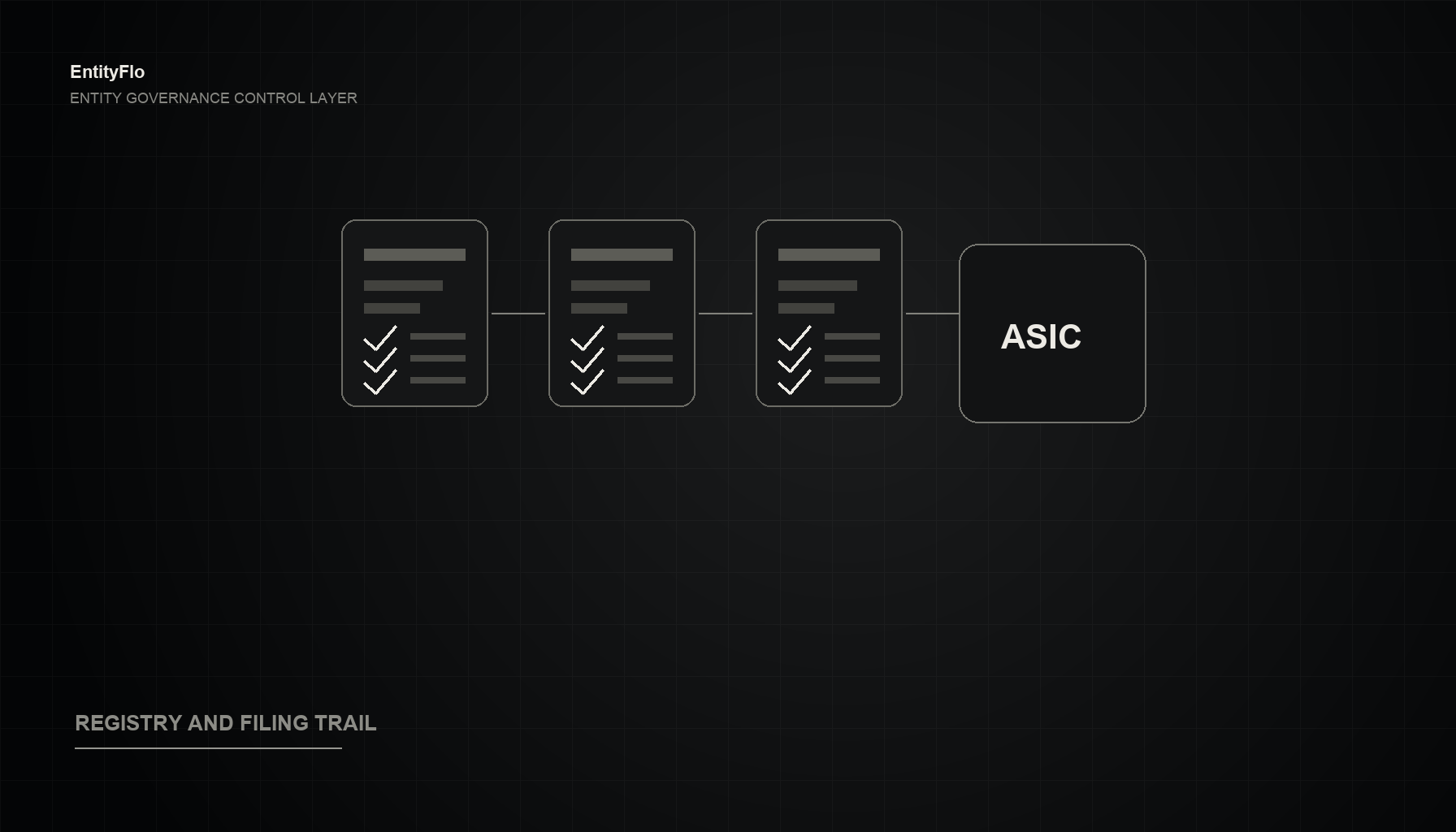
ASIC is overhauling its company register infrastructure in 2026 — and most compliance teams haven't heard about it yet. If your entity management setup still relies on manual ASIC lookups, CSV exports, and copy-pasting data between systems, the window to fix that is closing. Here's what's changing and why it matters.
What Is ASIC RegistryConnect?
ASIC RegistryConnect is ASIC's program to modernise its digital registry infrastructure by opening up direct API access to its company register for approved software providers. Under the program, ASIC is onboarding two categories of approved integrators:
- Digital Service Providers (DSPs) — software platforms that can lodge, retrieve, and sync company data directly with ASIC's register in real time
- Information Brokers — data intermediaries authorised to access and distribute ASIC registry data to third-party applications
The new APIs are slated for broader rollout in late 2026. Think of it as ASIC finally building the plumbing that lets compliant software speak directly to the source of truth — the Australian company register — without the friction, lag, or manual intervention that's defined the category for the last 20 years.
This is a structural shift. Not a feature update. A structural shift.
Why Now? What's Driving This?
ASIC has been under pressure to modernise its registry systems for years. The current ASIC EDGE system — while functional — was built for a different era. It handles bulk lodgements and data extracts but wasn't designed for the real-time, API-first world that modern compliance teams and governance platforms operate in today.
A few forces are accelerating the timeline:
1. The complexity of Australian corporate structures is increasing. Mid-market companies managing 50+ entities — holding companies, subsidiaries, joint ventures, trusts — are drowning in registry maintenance. Annual reviews, director changes, registered office updates — each one is a manual ASIC interaction. Multiply that by 100 entities and you've got a team spending weeks per year on pure admin.
2. Regulatory expectations are rising. ASIC's own Key Issues Outlook for 2026 signals that governance standards are under a microscope — particularly around beneficial ownership transparency, director accountability, and real-time accuracy of company records. The days of "we'll update ASIC next week" are numbered.
3. The Australian RegTech sector is maturing. ASIC has watched jurisdictions like the UK (Companies House API), Singapore (BizFile+), and Canada demonstrate that machine-readable, API-first company registers reduce compliance failures, speed up due diligence, and lower the cost of corporate governance. Australia is catching up.
The RegistryConnect program is ASIC's answer. And the compliance software vendors who move first will have a genuine structural advantage over those playing catch-up.
What Changes for Compliance Teams?
If you're a Company Secretary, CFO, or General Counsel managing an entity portfolio, here's what the RegistryConnect upgrade practically means for your day-to-day:
Real-time registry synchronisation. Right now, if a director changes address or resigns from a related entity, your internal records drift out of sync with ASIC almost immediately. Reconciling that gap is manual, time-consuming, and error-prone. With direct API access, compliant platforms can sync ASIC data automatically — meaning your entity register reflects reality, not last Tuesday's export.
Fewer manual lodgements. Today, lodging a change of director, updating a registered office, or processing an annual review statement involves navigating ASIC Connect or pushing through a registered agent. RegistryConnect-ready platforms will be able to handle these lodgements programmatically — initiated from within your governance software, validated against the live register, and confirmed in real time.
Audit trails that hold up. When ASIC (or a board, or an acquirer) asks for a complete record of your entity changes over the past five years, you need a clean audit trail. Manual processes leave gaps. API-integrated systems create verifiable, timestamped logs of every interaction with the register.
Reduced dependency on registered agents for routine tasks. A significant chunk of what registered agents charge for is ASIC interaction — lodgements, annual reviews, ASIC debt management. As DSP-enabled platforms absorb these workflows, compliance teams will have more control over their own registry interactions and lower costs for routine administration.
This doesn't eliminate the need for specialist advice. It eliminates the need for human-in-the-loop data entry on tasks that software can handle better.
The Competitive Divide: Early Integrators vs Everyone Else
Here's the uncomfortable reality: not every entity management platform will be RegistryConnect-ready when the APIs go live.
The incumbents in this space — CAS 360, NowInfinity (Class), Computershare Governance Services — all built their products around the existing ASIC EDGE architecture. They have large, established user bases and every commercial incentive to manage their technical transitions carefully (read: slowly). Migrating deeply integrated codebases to new API standards is expensive and risky for mature products with legacy infrastructure.
New-generation platforms that were built API-first, without the EDGE-era baggage, are in a fundamentally better position to integrate early.
For compliance teams evaluating software in 2026, this is a real selection criterion. When ASIC's new APIs go live, the question isn't just "does this software do what I need today?" — it's "will this software keep up with where ASIC is going?"
You don't want to be locked into a platform doing a 12-month integration project in 2027 while your registry data is falling behind.
What You Should Be Asking Your Current Software Provider
If you're already using entity management software — or evaluating platforms — here are the questions that matter right now:
1. Are you an approved Digital Service Provider under ASIC's RegistryConnect program? This is a yes/no question. If they can't answer it, that tells you something.
2. What's your roadmap for real-time ASIC registry sync? Look for specifics — timelines, API integration milestones, beta program details. "We're watching the space" is not an answer.
3. How do you currently handle ASIC data reconciliation? Manual processes with CSV exports and scheduled syncs are yesterday's answer. Understand the gap between where they are now and where RegistryConnect takes them.
4. What's your lodgement capability? Can you lodge directly from the platform, or does every ASIC interaction still go through a registered agent or manual portal login?
The right answers here separate the platforms that are built for where corporate governance is going from the ones managing their way through a transition they didn't design for.
What ASIC Is Actually Building Toward
Step back from the immediate API changes and look at the direction of travel.
ASIC's digital infrastructure investment isn't just about APIs. It's part of a broader push toward a more transparent, real-time, machine-readable Australian business register. The implications downstream include:
- Automated compliance monitoring — ASIC will eventually have the technical capability to detect anomalies (director disqualifications, deregistration candidates, beneficial ownership changes) in near real-time
- Faster due diligence — M&A, investment, and lending decisions that currently take weeks to validate against registry data will compress significantly
- Greater accountability for officeholders — When the register is accurate and real-time, there are fewer places to hide disclosure failures
For compliance teams, this is a net positive. Less manual reconciliation, better data, cleaner audit trails. But only if your tooling is ready for it.
The compliance teams still running manual spreadsheet-and-ASIC-Connect workflows in 2027 will be the ones scrambling to catch up — not just with their software, but with regulatory expectations that assumed modern tooling would handle the basics.
The Bottom Line
ASIC RegistryConnect is one of the most significant upgrades to Australia's corporate registry infrastructure in a generation. It's not making headlines because it's still in rollout — but the compliance software platforms paying attention are already preparing for it.
If you're managing 20, 50, or 200+ entities across a corporate structure, the question isn't whether real-time registry sync will become standard. It will. The question is whether your current tooling will get you there without a painful migration project in two years.
For compliance teams evaluating their options: this is the right time to look at what next-generation entity management software looks like — and whether your current platform has a credible path to RegistryConnect integration.
You can review ASIC's current information about its registry systems and the RegistryConnect program directly at asic.gov.au and monitor updates as the DSP and Information Broker API rollout progresses.
About the author: Nathan Carroll is the founder of EntityFlo, a corporate governance and entity management platform built for Australian CFOs, Company Secretaries, and General Counsel managing complex entity portfolios.
EntityFlo's Registry Sync feature is built for the API-first era of ASIC compliance. If you're managing a complex entity portfolio and want to see how real-time registry synchronisation works in practice — [book a demo](https://entityflo.com/demo) or join the waitlist at [entityflo.com](https://entityflo.com).