Director Compliance Software Australia
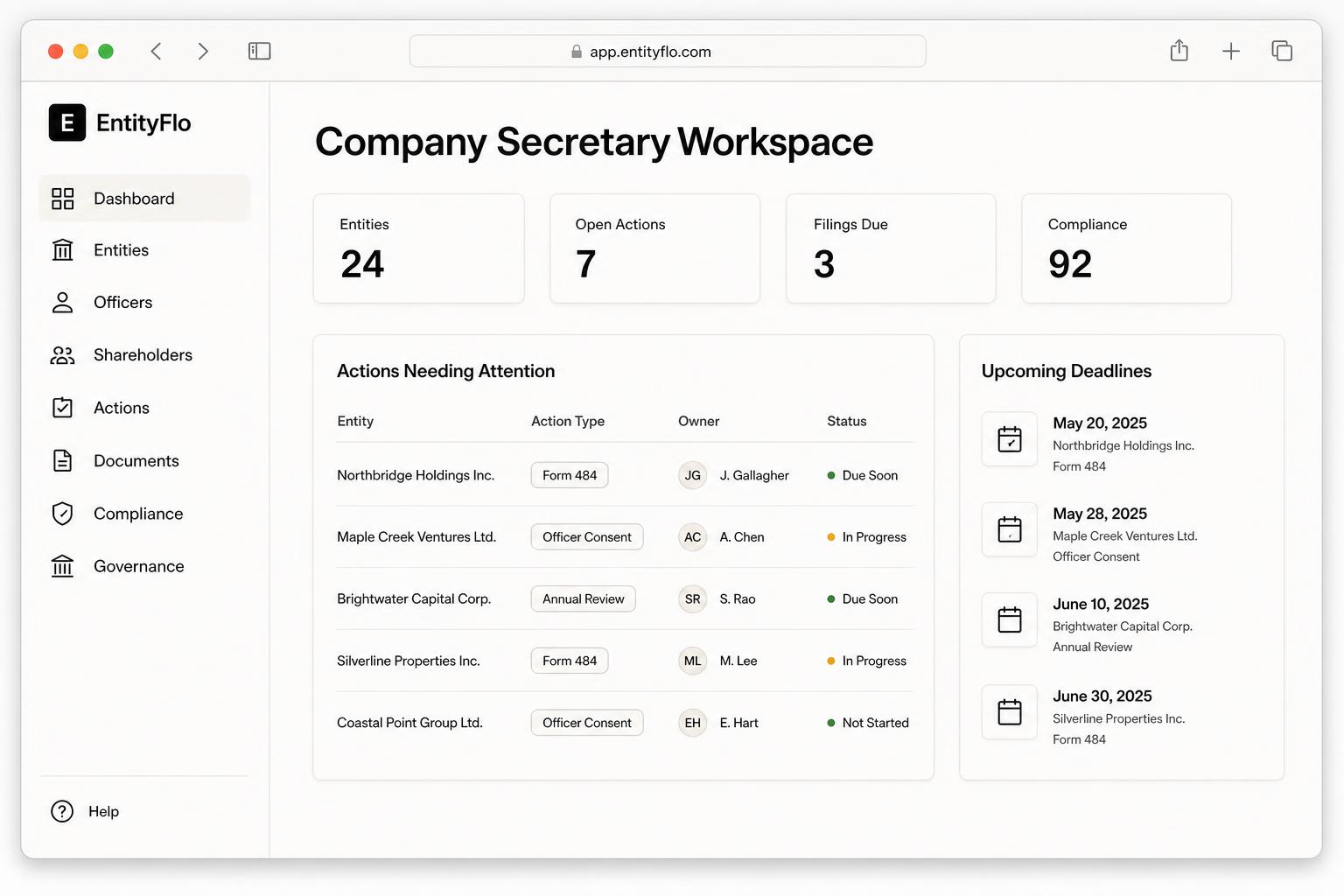
Directors carry personal liability for governance failures. EntityFlo ensures every appointment is properly documented, every obligation is tracked, and every filing is lodged on time.
Your first entity is free. No credit card required.
Director Compliance Software Australia
Directors carry personal liability for governance failures. EntityFlo ensures every appointment is properly documented, every obligation is tracked, and every filing is lodged on time.
Join BetaDirector Obligations Under Australian Law
Directors of Australian companies carry significant personal obligations under the Corporations Act 2001. These include duties of care and diligence, duties to act in good faith and in the best interests of the company, duties to avoid conflicts of interest, and obligations to prevent insolvent trading. Beyond these overarching duties, directors must comply with specific administrative requirements — consenting to appointment, disclosing interests, and ensuring the company meets its regulatory obligations. For individuals who serve as directors across multiple entities in a corporate group, the compliance burden multiplies with each appointment. Every entity requires its own set of consents, interest disclosures, and compliance tracking. Without systematic management, it becomes impossible to maintain complete and accurate records across all directorships.
The Compliance Gap in Director Management
Most organisations track director details in spreadsheets or basic contact databases. These tools record who holds which positions but fail to manage the lifecycle of each appointment — the consent to act, the initial ASIC lodgement, ongoing interest disclosures, identity verification, and eventual cessation. This creates compliance gaps that are invisible until they matter. A director may have been appointed years ago without a signed consent to act. Interest disclosures may be outdated or incomplete. ASIC records may not reflect current appointments because Form 484s were never lodged. These gaps represent governance failures that expose both the company and individual directors to regulatory risk. For corporate groups where individuals hold directorships across multiple entities, the complexity of tracking these obligations manually becomes untenable. A single individual might require dozens of consent forms, interest disclosures, and compliance checks across the group.
Automated Director Lifecycle Management
EntityFlo manages the complete director lifecycle from appointment through to cessation. When a new director is appointed, the platform creates a structured workflow that includes consent to act documentation, ASIC Form 484 preparation and lodgement, officer register updates, compliance engine assessment, and identity verification tracking. Throughout the director's tenure, EntityFlo monitors ongoing obligations — interest disclosures, residential address currency, identity document expiry, and any entity-specific requirements. The compliance engine flags missing or expired items with severity ratings, ensuring that gaps are identified and addressed before they become regulatory issues. When a director ceases, EntityFlo manages the cessation workflow — generating cessation notices, lodging Form 484 with ASIC, updating registers, and adjusting compliance requirements across all affected entities. The complete appointment history is retained in the audit trail for future reference.
Cross-Entity Director Visibility
EntityFlo's officer management provides a unified view of every individual's directorships across the corporate group. For each person, you can see every entity they're appointed to, their role at each entity, the status of their consent and compliance documentation, and any outstanding obligations. This cross-entity visibility is critical for governance teams managing corporate groups where the same individuals serve across multiple entities. It enables proactive management of director obligations, early identification of compliance gaps, and efficient bulk processing of updates when a director's details change. The beneficial ownership module extends this visibility by showing how director appointments interact with ownership structures — essential for UBO transparency and conflicts of interest management.
Conflict of Interest Management
Directors have a legal obligation to disclose material personal interests to the board. EntityFlo provides a structured framework for managing these disclosures — directors can declare interests, the governance team can assess materiality, management strategies can be documented, and the complete disclosure history is maintained in the conflicts register. The platform tracks both standing disclosures and transaction-specific disclosures, ensuring that the company maintains a complete record of all director interests. Automated reminders prompt annual reviews of standing disclosures, and the governance calendar integrates conflict reviews with regular board meeting cycles. For corporate groups, EntityFlo shows how a director's interests at one entity might affect their position at related entities — providing the group-wide conflict visibility that manual processes cannot achieve.
Why EntityFlo for Director Compliance
EntityFlo transforms director compliance from a fragmented administrative task into a systematic, automated process. Every director obligation is tracked across every entity, every document is linked to its governance context, and every filing deadline is monitored with advance alerts. As a integrated with ASIC, EntityFlo can lodge director appointment and cessation forms directly, reducing the time between governance decision and regulatory notification. Combined with automated consent generation, compliance monitoring, and conflict management, EntityFlo provides the complete director governance infrastructure that protects both the organisation and its directors from compliance failures.
Explore related features
See how EntityFlo connects across the platform.
Frequently asked questions
What director documents does EntityFlo track?
EntityFlo tracks consent to act forms, interest disclosures, identity verification, residential address declarations, ASIC filings (Form 484), and any entity-specific director documentation.
Can EntityFlo track a director across multiple entities?
Yes. EntityFlo provides a unified view of every directorship an individual holds across the corporate group, with consolidated compliance tracking and obligation management.
How does EntityFlo handle director conflicts of interest?
EntityFlo provides a structured conflict register with standing and transaction-specific disclosures, materiality assessment, management strategy documentation, and annual review reminders.
Does EntityFlo file director changes with ASIC?
Yes. As a integrated with ASIC, EntityFlo can lodge Form 484 for director appointments, cessations, and detail changes directly through its integration.
Take control of your entity portfolio.
Your first entity is free. No credit card, no lock-in. Set up in under 15 minutes.
Entity Register
Every entity, officer and shareholder in one live register.
ExploreGovernance Workflows
From board decision to registered outcome. Every step tracked.
ExploreCompliance Engine
Continuous compliance monitoring across every entity.
ExploreStructure & Ownership
Live structure charts, ownership chains and UBO traces across the group.
ExploreBoardroom
Run board meetings, papers, resolutions and minutes from one place.
ExploreFloSec AI
Your AI Company Secretary across every record, action and obligation.
ExploreWe use cookies to improve your experience. Essential cookies are always active. You can accept all cookies or choose essential only.