Entity Compliance Australia
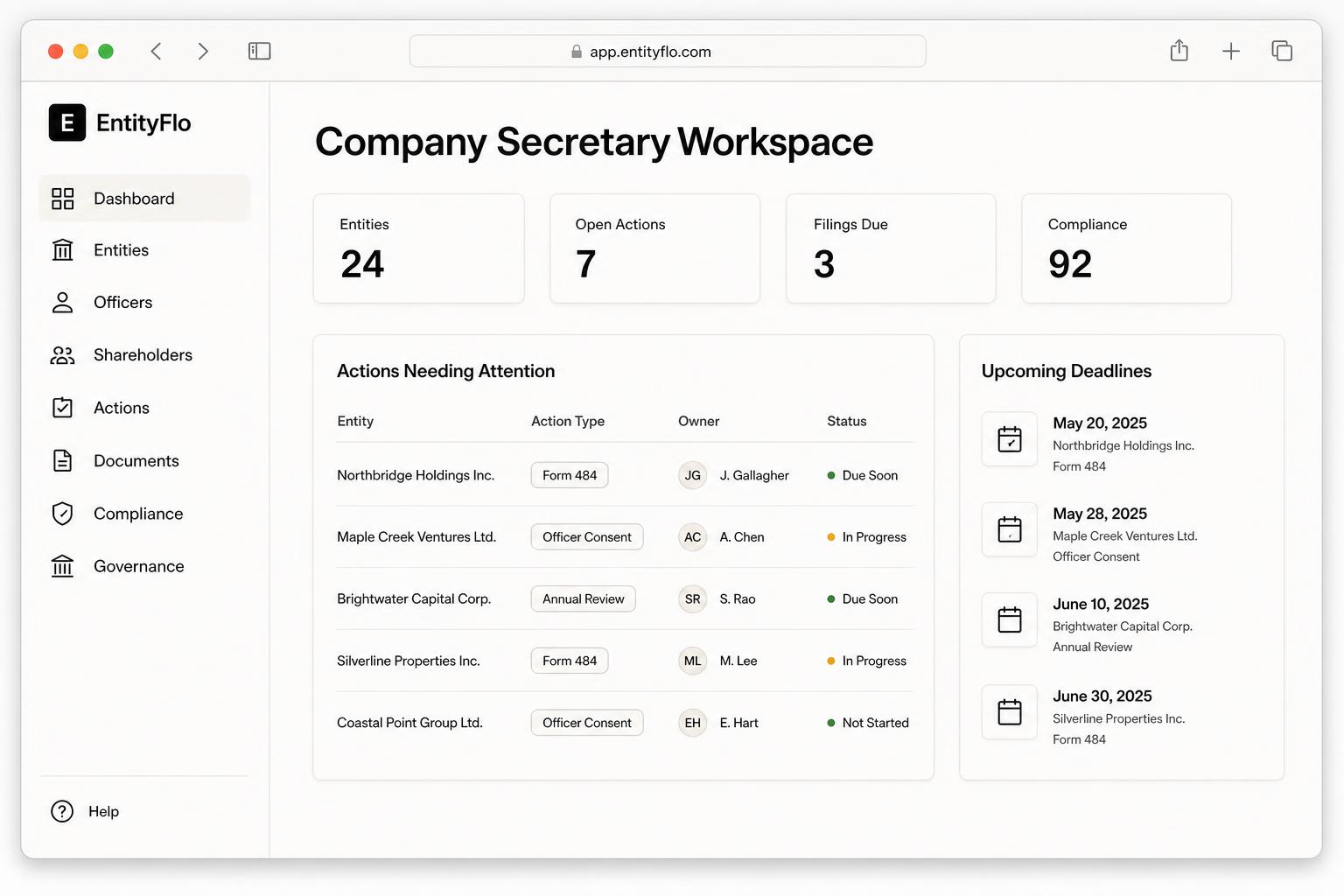
Every Australian company has ongoing ASIC compliance obligations. Missing them means late fees, director liability, and potential deregistration. EntityFlo monitors every entity's compliance status in real time so nothing falls through the cracks.
Your first entity is free. No credit card required.
Entity Compliance Australia
Every Australian company has ongoing ASIC compliance obligations. Missing them means late fees, director liability, and potential deregistration. EntityFlo monitors every entity's compliance status in real time so nothing falls through the cracks.
Join BetaWhat Entity Compliance Means in Australia
Entity compliance in Australia refers to the ongoing obligations that every registered company must meet to remain in good standing with ASIC and under the Corporations Act. These obligations don't stop at registration — they continue for the life of the entity and vary based on company type, size, and activity. For corporate groups managing multiple entities, compliance management multiplies in complexity. Each entity has its own compliance calendar, its own officer obligations, its own ASIC correspondence, and its own registered office requirements. Managing this manually across dozens of entities is one of the highest-risk activities in corporate governance.
ASIC Annual Reviews: The Core Compliance Event
The ASIC annual review is the primary recurring compliance event for every Australian proprietary company. ASIC issues an annual statement each year, and companies must confirm their details are correct, pay the annual review fee, and lodge any required amendments within 28 days of the review date. Missing the annual review results in late fees, and persistent failure to respond leads to deregistration. For corporate groups with dozens of entities — each with different review dates throughout the year — tracking annual reviews manually is a significant compliance risk. EntityFlo's Compliance Engine tracks every entity's annual review date, generates reminder alerts in advance, and flags overdue reviews immediately.
Officer Obligations and Director Duties
Australian companies must maintain accurate officer records with ASIC at all times. When a director is appointed or resigns, a Form 484 must be lodged within 28 days. Failure to lodge on time is a strict liability offence. Officers must also maintain their own obligations under the Corporations Act — duties of care, solvency awareness, conflict disclosure, and more. EntityFlo tracks officer appointment dates, consent records, and lodgement status for every entity in the portfolio. When a director change occurs, FloSec AI generates the Form 484 automatically from live entity data and queues it for ASIC registered agent lodgement (#54164) — within the platform, without portal access. No deadline is missed because the system catches it before it's an issue.
Registered Office Requirements
Every Australian company must maintain a registered office address that is open to the public during business hours. The registered office cannot be a residential address unless the company operates from that address. Changes must be lodged with ASIC promptly. EntityFlo maintains registered office records for every entity and tracks any changes. Registry Sync continuously compares the registered office on record with what ASIC holds, alerting immediately when a mismatch is detected. For corporate groups that have moved offices or restructured, Registry Sync catches any entities where the address update wasn't lodged.
The EntityFlo Compliance Engine: Real-Time Entity Scoring
EntityFlo's Compliance Engine doesn't wait for deadlines to surface compliance issues. It continuously scores every entity in your portfolio on a 0–100 scale, assessing compliance across all ASIC requirements — registered office, officer appointments, annual review status, share register accuracy, outstanding lodgements, and more. When a score drops — because a director hasn't been formally appointed after a verbal agreement, or an address change hasn't been lodged — the system flags it immediately. You see exactly which entities are at risk, what the specific issue is, and what action is required. Compliance becomes proactive rather than reactive.
Registry Sync: Know What ASIC Actually Holds
One of the most common compliance failures in Australian corporate groups is data drift — where internal records say one thing and ASIC's registry says another. It accumulates quietly over time: a director change that was processed internally but the form was never lodged, an address update that was verbally communicated but never formalised, a share allotment that wasn't updated on the ASIC register. EntityFlo's Registry Sync reconciles your internal entity data against ASIC's live registry continuously. Every discrepancy is surfaced as an action item. Your team always knows what ASIC actually holds versus what your records say — across every entity in the portfolio, simultaneously.
Document Retention and Audit Trail
Australian corporations law requires companies to maintain certain records — financial records, registers, minutes, and resolutions — for defined periods. For corporate groups, ensuring consistent document retention across every entity is a governance challenge. EntityFlo's Document Vault stores all governance documents — minutes, resolutions, ASIC form lodgements, consent forms, share certificates — with version history and a complete audit trail. Every user action is logged with a timestamp. For regulatory reviews, due diligence processes, or internal audits, the complete governance history of every entity is available on demand.
Explore related features
See how EntityFlo connects across the platform.
Frequently asked questions
What are the main ASIC compliance obligations for Australian companies?
Key obligations include: maintaining a registered office, keeping accurate officer and shareholder registers, lodging changes within 28 days, responding to ASIC annual reviews within 28 days, and paying annual review fees on time. Failure to comply results in late fees, penalties, or deregistration.
What happens if an ASIC annual review is missed?
Missing the 28-day window results in a late fee. If the annual review is ignored entirely, ASIC may commence deregistration proceedings. Deregistration removes the company's legal existence, which can have significant consequences for any contracts, assets, or obligations held in the entity.
How does EntityFlo monitor entity compliance?
EntityFlo's Compliance Engine scores every entity 0–100 in real time against ASIC's compliance requirements. Low scores trigger automatic alerts. The system identifies specific compliance gaps — not just overdue deadlines — so your team can act before a breach occurs.
Can EntityFlo lodge ASIC forms directly?
Yes. EntityFlo is an ASIC Digital Service Provider. Forms generated by FloSec AI — including Form 484 for officer changes — are lodged directly to ASIC without portal access. Lodgement confirmation is captured in the entity's audit trail.
How does EntityFlo detect compliance gaps across many entities?
EntityFlo's Registry Sync continuously reconciles internal records against ASIC's live data for every entity. Combined with real-time Compliance Engine scoring, this means gaps are detected automatically regardless of how many entities are in the portfolio.
Take control of your entity portfolio.
Your first entity is free. No credit card, no lock-in. Set up in under 15 minutes.
Entity Register
Every entity, officer and shareholder in one live register.
ExploreGovernance Workflows
From board decision to registered outcome. Every step tracked.
ExploreCompliance Engine
Continuous compliance monitoring across every entity.
ExploreStructure & Ownership
Live structure charts, ownership chains and UBO traces across the group.
ExploreBoardroom
Run board meetings, papers, resolutions and minutes from one place.
ExploreFloSec AI
Your AI Company Secretary across every record, action and obligation.
ExploreWe use cookies to improve your experience. Essential cookies are always active. You can accept all cookies or choose essential only.