Entity Management Database
Spreadsheets are not a database. They can't enforce data integrity, sync with ASIC, or score compliance in real time. EntityFlo is the entity management database that replaces the spreadsheet — and everything you've been trying to do with it.
Your first entity is free. No credit card required.
Entity Management Database
Spreadsheets are not a database. They can't enforce data integrity, sync with ASIC, or score compliance in real time. EntityFlo is the entity management database that replaces the spreadsheet — and everything you've been trying to do with it.
Join BetaWhat Is an Entity Management Database?
An entity management database is a structured, centralised data store that holds all information about your legal entities — companies, trusts, partnerships, and other structures — in a single, authoritative record. It tracks officer appointments, shareholder registers, compliance obligations, key dates, documents, and regulatory status in a format that's accessible, searchable, and auditable. Unlike a spreadsheet, a proper entity management database enforces data integrity — it doesn't allow an entity to have two registered offices, a director with no appointment date, or a compliance obligation without a responsible party. It maintains relationships between data points, tracks change history, and provides a single source of truth that multiple users can access simultaneously without version conflicts.
Why Spreadsheets Fail as Entity Databases
Every corporate group starts with spreadsheets. They're flexible, familiar, and free. For three entities, they work. For thirty, they become a governance liability. Spreadsheets can't enforce referential integrity — nothing stops a user from entering an invalid date, duplicating an entity, or leaving a required field blank. They have no audit trail — you can't see who changed a director's name or when a compliance note was added. They can't alert you when a deadline is approaching or a compliance gap emerges. They can't sync with ASIC to verify that what you hold matches what the registry holds. And they become the single point of failure for an entire governance function when the person who maintains them leaves.
Live ASIC Sync: The Database That Knows What the Registry Holds
EntityFlo's entity management database is connected to ASIC's live registry through Registry Sync. Every entity in your database is continuously reconciled against ASIC's actual records — officer names, registered office addresses, share structures, and lodgement history. When your database and ASIC's registry diverge — because a lodgement was missed, a change was processed internally but not filed, or an ASIC update created a discrepancy — the mismatch is detected automatically and surfaced as an action item. You always know what ASIC actually holds versus what your database says. No manual reconciliation required.
Data Structure: What a Proper Entity Database Contains
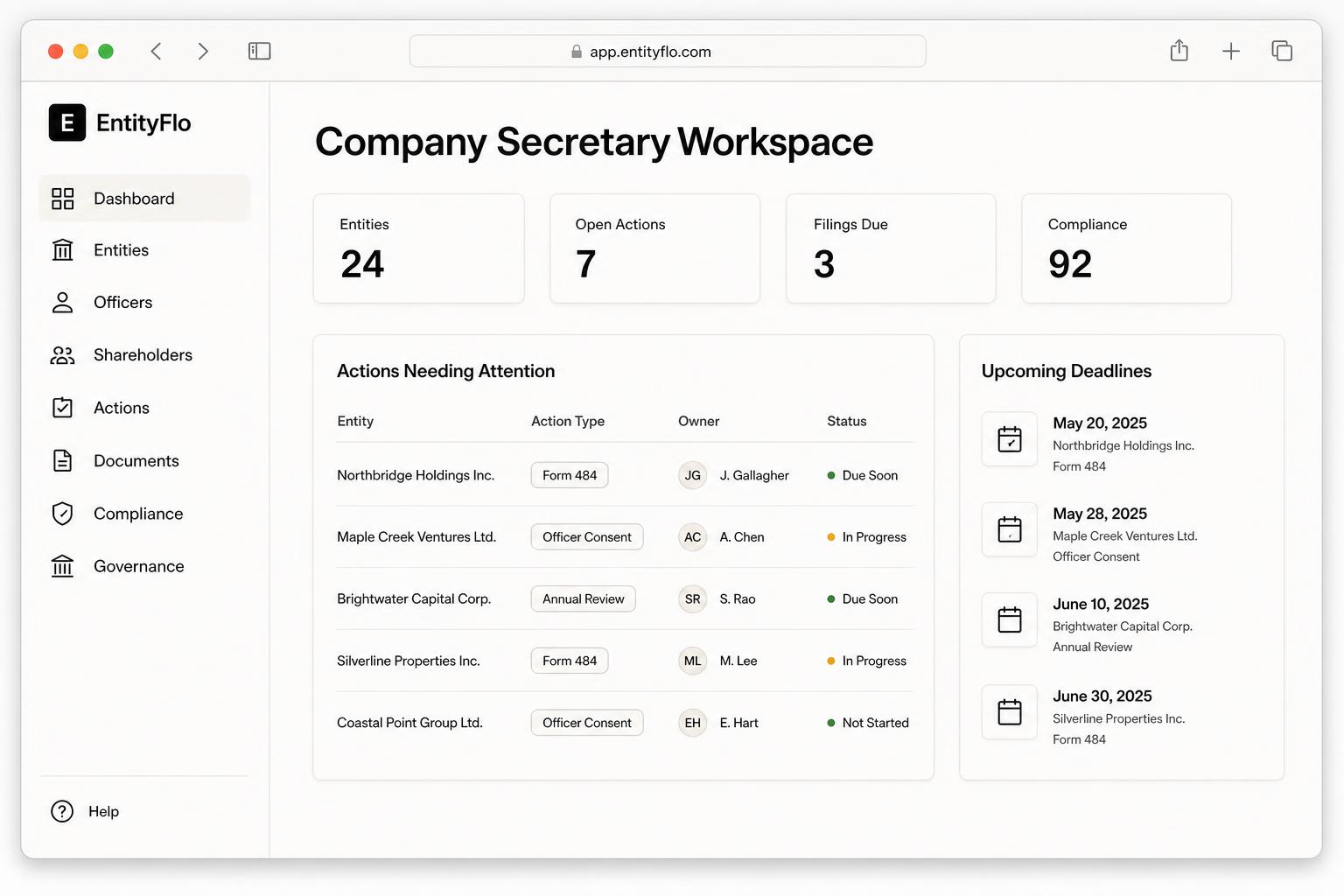
EntityFlo's entity database stores a complete profile for every entity: registered name, ACN/ABN, entity type, jurisdiction, registered office, principal place of business, company class, and registration date. Each entity links to its full officer register — current and historical directors and secretaries with appointment dates, cessation dates, and consent records. Shareholder data is captured with transfer history, share class, percentage ownership, and UBO mapping. Compliance obligations are tracked against the entity's specific requirements. Documents are stored in the entity's document vault with version control. Every change to any data point is recorded in the audit trail. This is what a database does that a spreadsheet cannot.
AI Over the Database: FloSec AI and the Compliance Engine
EntityFlo doesn't just store entity data — it acts on it. FloSec AI reads the database to draft documents, generate ASIC forms, and answer governance questions from live data rather than templates. When a director appointment needs to be processed, FloSec AI reads the entity's current officer register, generates the correct Form 484 with pre-filled details, and queues it for ASIC registered agent lodgement (#54164). The Compliance Engine runs a continuous scoring model over the entire database. Every entity receives a real-time compliance score calculated against ASIC's rule set. When the score changes — because an officer record is incomplete, a filing is overdue, or an annual review is approaching — the platform surfaces the issue immediately. The database isn't passive storage. It's an active compliance monitoring system.
Single Source of Truth Across the Organisation
In most organisations without a dedicated entity database, governance information is distributed across multiple systems and people. The CFO has the shareholder register. The Company Secretary has the ASIC correspondence. The legal team has the trust deeds. No single person or system has the complete picture. EntityFlo creates a single source of truth — one place where every entity's complete governance record lives. Role-based access controls determine what each user can see and do. CFOs see the portfolio compliance dashboard. Company Secretaries have full entity management access. Directors can see their own appointments and consents. Auditors can run reports on the full governance history. Everyone works from the same data, simultaneously, without conflicts.
From Spreadsheet Migration to Operational Database
Migrating from spreadsheets to EntityFlo's entity database is supported by EntityFlo's onboarding team. We import your existing entity data, map it to the EntityFlo data structure, and reconcile it against ASIC's live registry to identify and resolve any discrepancies before go-live. Most clients are fully operational within 2–4 weeks. Beta clients including Lederer Group and Pallas Capital completed migration and moved from spreadsheet-based governance to a live, AI-native entity database in that timeframe. Once live, the platform maintains itself — Registry Sync keeps ASIC data current, and the Compliance Engine monitors the database continuously.
Explore related features
See how EntityFlo connects across the platform.
Frequently asked questions
What is an entity management database?
An entity management database is a centralised, structured system that holds all information about your legal entities — officers, shareholders, compliance obligations, documents, and regulatory status — in a single source of truth. Unlike spreadsheets, it enforces data integrity, maintains audit trails, and can sync with live regulatory data.
Why can't spreadsheets serve as an entity database?
Spreadsheets lack data integrity enforcement, audit trails, live regulatory sync, automated compliance monitoring, and role-based access controls. As the entity portfolio grows, they become a governance liability rather than a governance tool.
How does EntityFlo sync with ASIC?
EntityFlo's Registry Sync feature continuously reconciles entity data against ASIC's live registry. Mismatches between your database and ASIC records are detected automatically and surfaced as action items for resolution.
Can multiple people use the entity database simultaneously?
Yes. EntityFlo is a multi-user platform with role-based access controls. CFOs, Company Secretaries, legal teams, and directors all access the same database simultaneously with appropriate permissions — without version conflicts or data duplication.
How long does it take to migrate from spreadsheets to EntityFlo?
Most clients complete migration in 2–4 weeks. EntityFlo's team handles the import, reconciles data against ASIC records, and ensures the database is accurate and complete before your team goes live.
Take control of your entity portfolio.
Your first entity is free. No credit card, no lock-in. Set up in under 15 minutes.
Entity Register
Every entity, officer and shareholder in one live register.
ExploreGovernance Workflows
From board decision to registered outcome. Every step tracked.
ExploreCompliance Engine
Continuous compliance monitoring across every entity.
ExploreStructure & Ownership
Live structure charts, ownership chains and UBO traces across the group.
ExploreBoardroom
Run board meetings, papers, resolutions and minutes from one place.
ExploreFloSec AI
Your AI Company Secretary across every record, action and obligation.
ExploreWe use cookies to improve your experience. Essential cookies are always active. You can accept all cookies or choose essential only.