Boardroom.
Where decisions get made.
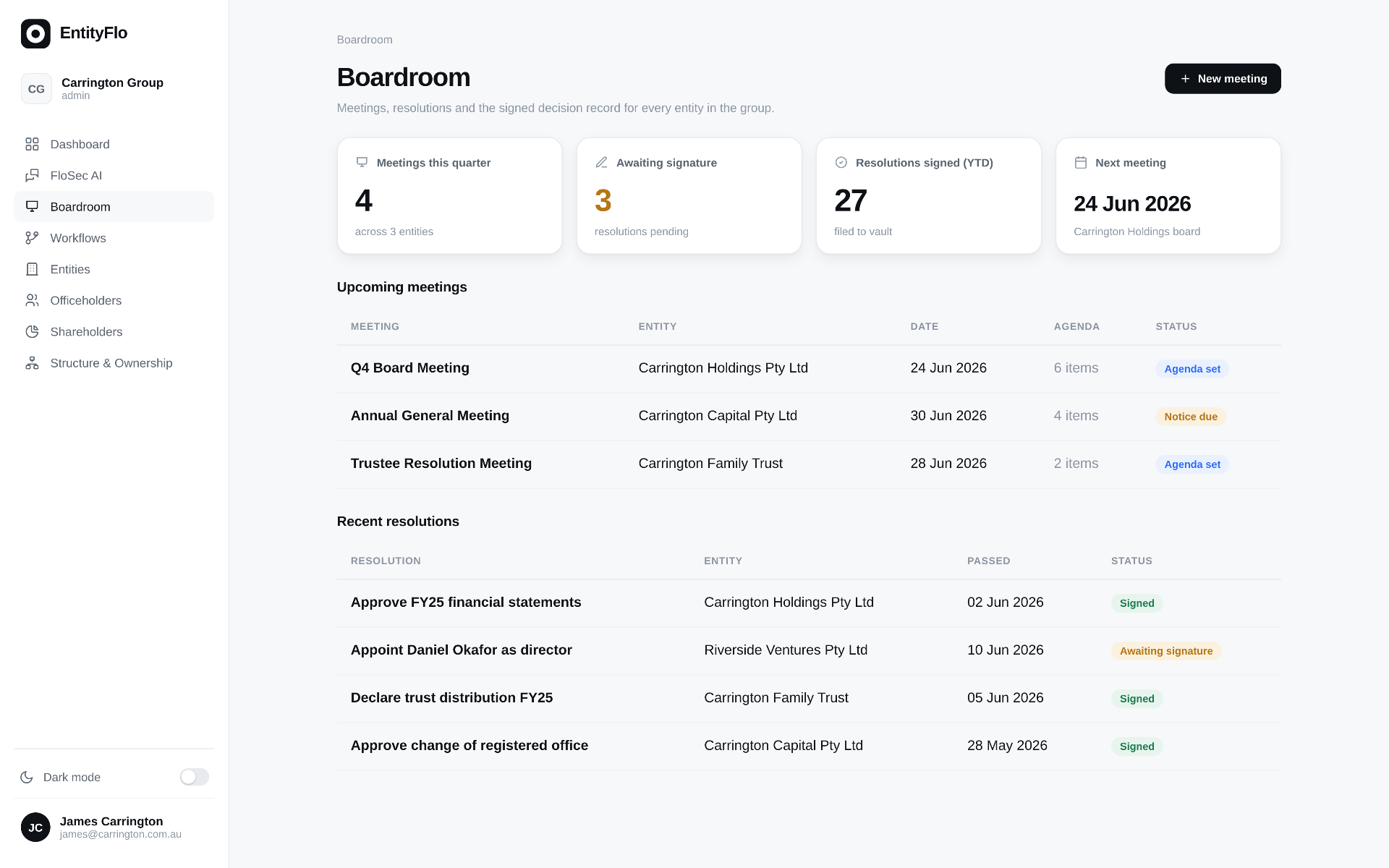
Every meeting, committee, and circular resolution — run in one place. Agendas built from live entity data. Packs assembled in seconds. Quorum validated, votes captured. FloSec AI captures the minutes, drafts the resolutions, circulates them for signing, and creates the Actions that follow — automatically.
Your first entity is free. No credit card required.
Board work lives in too many places.
Agendas in Word. Packs in Dropbox. Minutes in someone's notebook. Resolutions on email. By the time the meeting starts, half the documents are already out of date — and no one is sure who signed what.
Packs assembled by hand
Cosec chases reports from finance, legal, and ops the week before every meeting. PDFs are stitched together at 9pm the night before.
Quorum verified after the fact
Director attendance is checked from memory. Quorum failures are only caught when minutes are being written — and resolutions get re-run.
Resolutions lost in email
Circular resolutions sit in someone's inbox waiting for the last signature. Registers don't update until weeks later — if at all.
Minutes written from scratch
Every meeting ends with someone writing 8 pages of minutes from a sparse set of notes. Attribution is wrong. Decisions get lost.
One Boardroom for every decision.
EntityFlo's Boardroom runs the full lifecycle — from agenda to filed resolution — without leaving the platform. FloSec AI prepares the work. Directors make the decisions. The record updates itself.
Join BetaLive agendas, not static documents
Agendas pull from real entity data — open actions, outstanding consents, due filings — so nothing is missed and nothing is stale.
Packs in seconds, not days
Board packs assemble themselves from the latest registers, financial summaries, and outstanding items. One click, one PDF, every time.
Quorum validated before the meeting
EntityFlo checks attendance against constitutional quorum rules in real time. Conflicts flagged. Eligibility confirmed before voting opens.
FloSec AI drafts the minutes and resolutions
During the meeting FloSec AI captures decisions, drafts resolutions in your house style, and circulates them for signature — citing the exact constitutional clause.
Decisions become Actions automatically
If a meeting appoints a director or approves a share issue, the corresponding Action is created in one click — already pre-filled with the resolution.
Inside Boardroom.
The five capabilities that make boardroom work.
Meetings & Agendas
Attendees managed and quorum validated before the meeting starts.
ExploreResolutions
Drafted by FloSec AI, circulated, signed, and locked.
ExploreVoting & Quorum
Pass/fail logic tied to every motion.
ExploreBoard Packs
Assembled from live data, never chased.
ExploreMinutes & Records
FloSec AI-drafted, immutable, attributed, audit-ready.
ExploreThe rest of the platform.
Boardroom connects to every other pillar — decisions flow, records sync, nothing lives alone.
Take control of your
entity portfolio.
Your first entity is free. No credit card, no lock-in. Set up in under 15 minutes.
Entity Register
Every entity, officer and shareholder in one live register.
ExploreGovernance Workflows
From board decision to registered outcome. Every step tracked.
ExploreCompliance Engine
Continuous compliance monitoring across every entity.
ExploreStructure & Ownership
Live structure charts, ownership chains and UBO traces across the group.
ExploreBoardroom
Run board meetings, papers, resolutions and minutes from one place.
ExploreFloSec AI
Your AI Company Secretary across every record, action and obligation.
ExploreWe use cookies to improve your experience. Essential cookies are always active. You can accept all cookies or choose essential only.